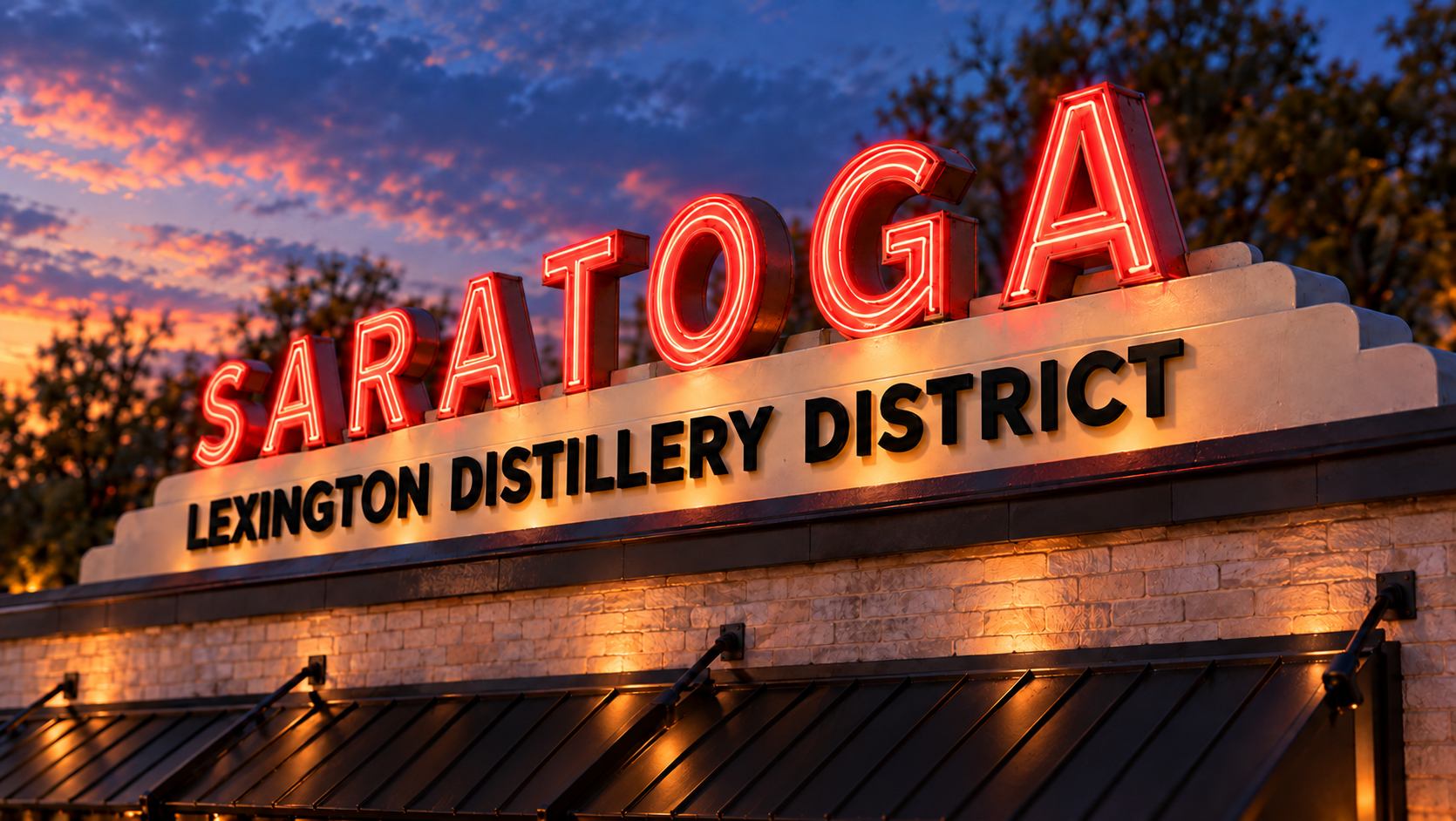
Across 45 years, Saratoga Restaurant became one of Lexington’s great gathering places. The familiar food. The unforgettable regulars. The owners and longtime staff who made an ordinary corner feel like home.
1937 Reynolds1944 R. & S.1950 Rose1954 Whitlock1978 Mims1995 Final closingMay 12, 2000 Demolition
01 / BEFORE THE SARATOGA
1937–1950 · 856 EAST HIGH STREET
A new building. A familiar corner.
Thirteen years before Saratoga opened, a brand-new luncheonette was already welcoming Lexington to this address.
The Reynolds articles move the building’s documented beginning back to June 1937. They describe a “new building,” new equipment and an owner with restaurant experience. The precise construction date remains unrecorded here, but the building was standing and open by these reports.
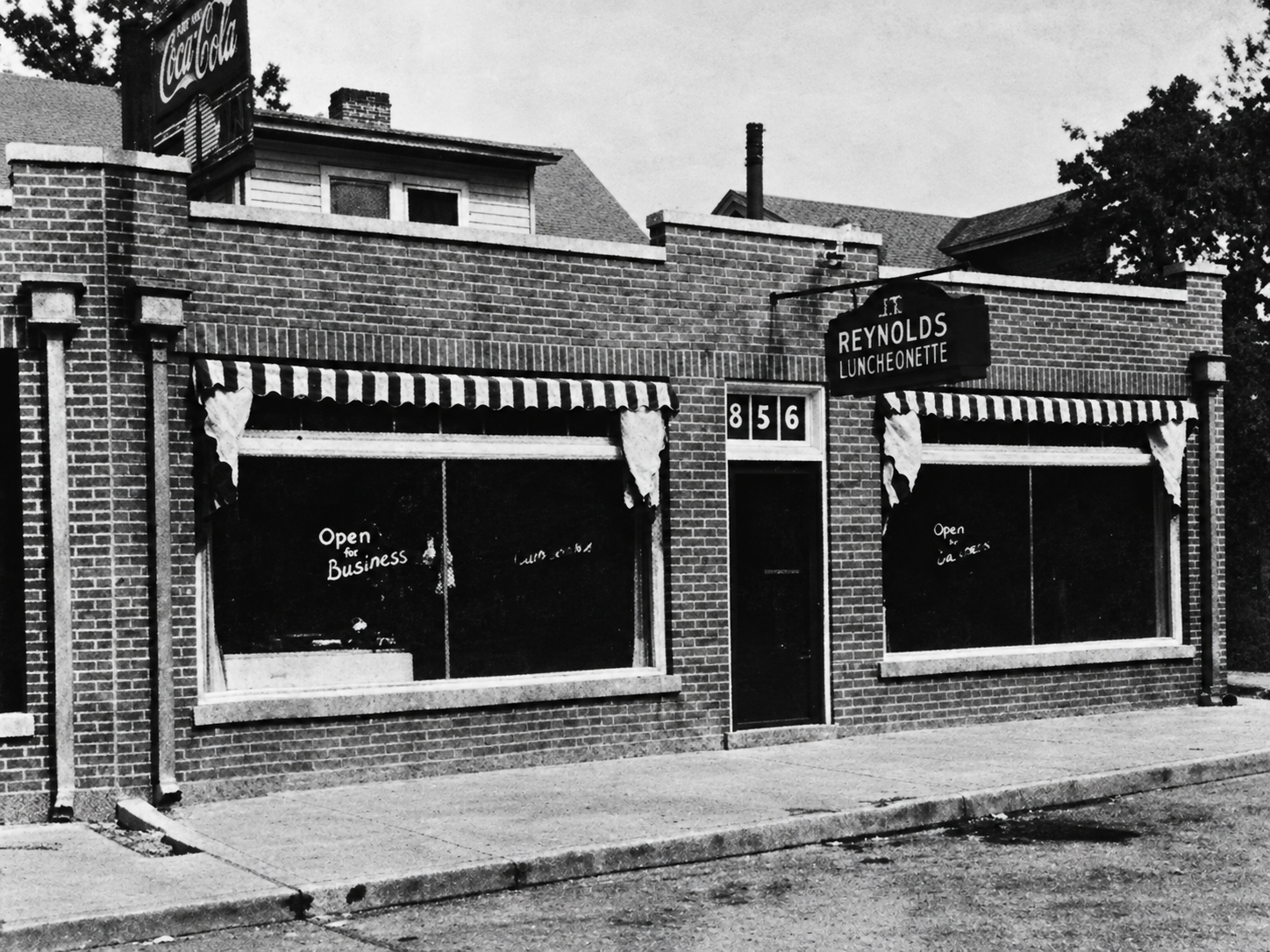
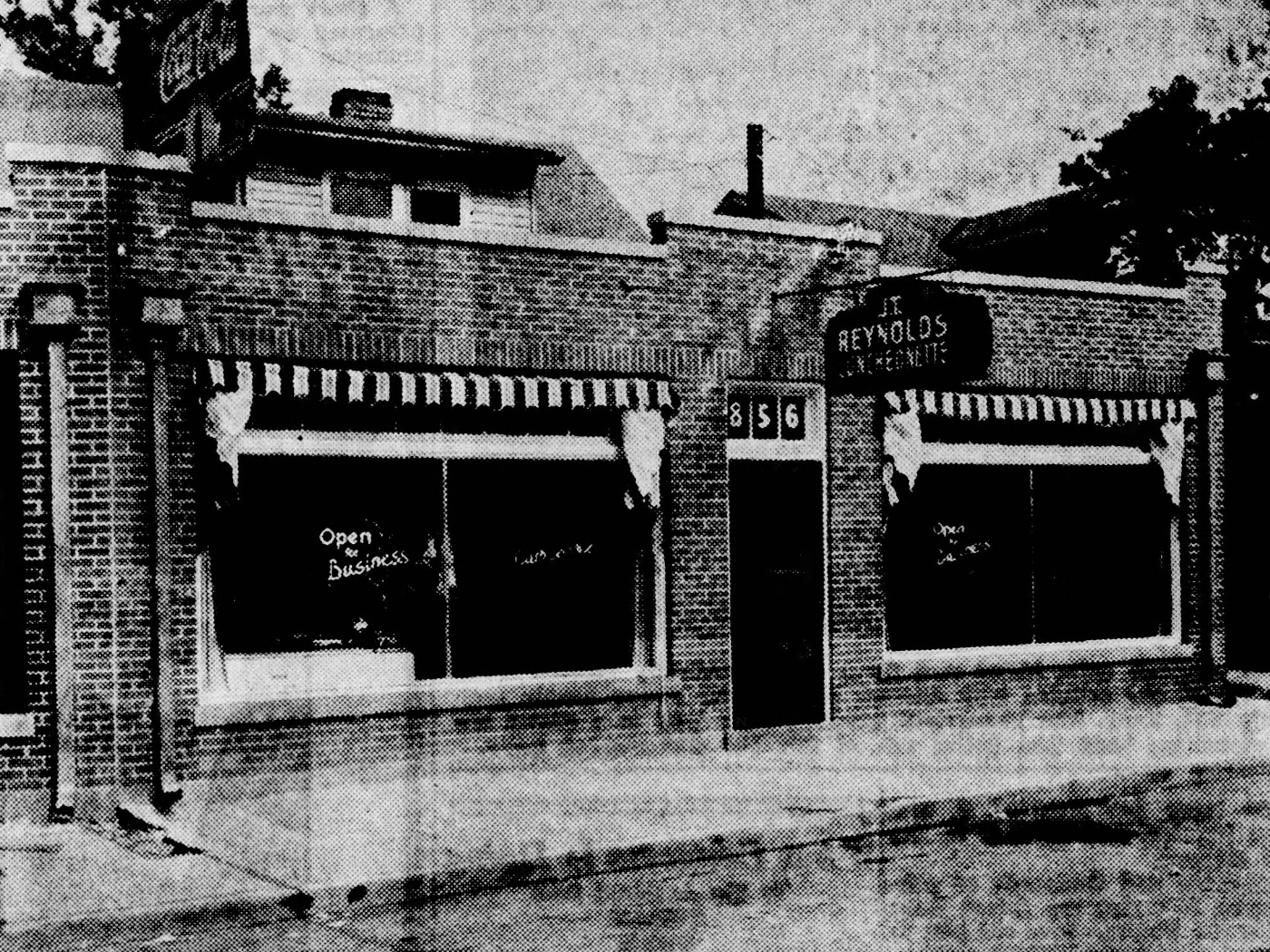
EARLIEST KNOWN PHOTO OF THE FUTURE SARATOGA
856 East High Street, June 1937
Move the divider to compare the newspaper photograph with the AI enhanced interpretation.
Original newspaper photoAI enhanced interpretation↔
Original photograph credited “Kenneth Photo.” The enhanced view interprets missing fine detail; the original scan remains the historical source. Open the complete article and photograph ↗
J. T. REYNOLDS · JUNE 1937
A restaurant from the start
Reynolds’s earlier business was the Reynolds Sandwich Shop at 225 Walton Avenue, sold to his brother the previous November. On East High, his new luncheonette served chicken, steak and old ham dinners, sandwiches and a merchant’s lunch.
Four booths and four tables filled the front lunchroom, with seven tables in the rear. Together, they seated about 74 people. The main interior was green and cream; the rear dining room used a colonial design.
It opened at 7 a.m. daily. Curb service ran until midnight, and delivery boys served southeastern Lexington. The report even mentioned the newly widened street and room for curbside parking.
THE REYNOLDS FAMILY · SEPTEMBER 1938
Home cooking, with Mrs. Reynolds
The following year brought a reopening as J. T. Reynolds’ Restaurant and Delicatessen. Ads put the home cooking under Mrs. J. T. Reynolds’s personal supervision: steaks, country ham, homemade chili, salads and sandwiches, plus a delicatessen, fountain, curb service and delivery.
News stories also connected Reynolds with Goodwin Brothers, Inc. The ads thanked Bryan-Hunt, Lyle’s Market, Swift’s Ice Cream and Central Tobacco. The record does not explain the temporary closure that preceded this reopening.
Later directories classify J. Trulon Reynolds as a confectioner at the same address. The contemporary restaurant articles show why “a candy company” alone would be too narrow a description.
1942–1943: a sale notice, an auction and a vacant location
Reynolds advertised the restaurant for sale on December 23, 1942. A December 27 notice scheduled its equipment auction for December 29: soda fountain, refrigerators, stove, grills, booths and the working contents of a restaurant. The January 1943 rental ad called the premises “formerly occupied by Reynolds Restaurant,” although it printed 858 East High rather than the usual 856. That discrepancy remains part of the record.
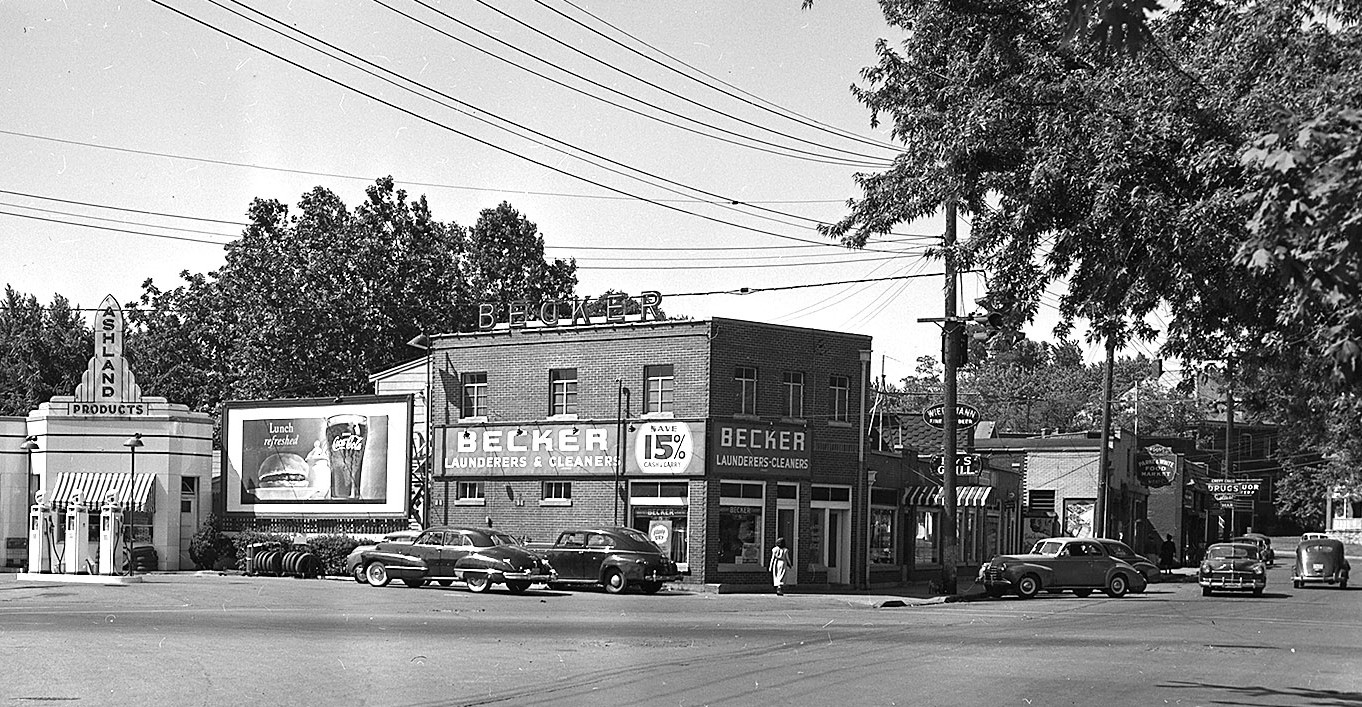
The March 1944 telephone directory lists R&S Grill, 856 East High, telephone 3946. The June 1949 streetscape captures the block before the Saratoga Restaurant sign. Who the initials stood for and exactly when Reynolds’s operation became R&S remain open questions.
In February 1950, the grill’s operators had lost their lease. An auction announced for February 7 offered seven tables, 35 chairs, eight counter stools, a soda fountain, four double booths and the kitchen equipment. Only months later, the Saratoga Restaurant name arrived.
↗Euclid Avenue Shopping Center · June 1949. UK Libraries Special Collections, photograph 1.04-790.
All ten early scans—including both newspapers’ 1938 reopening advertisements and reports—appear individually in the complete collection.
02 / THE ROSE YEARS
1950–1954 · THE NAME ARRIVES
FORMAL OPENING · MAY 1950
And then came Saratoga.
“Lexington’s Smartest Restaurant.” A confident beginning for a name that would outlive the building.
The April 20 hiring advertisement called for a first-class chef for a restaurant opening May 1. The May 3 formal-opening ad made the ambition plain: family dining from 7 a.m. to midnight, sizzlin’ steaks, seafood, chicken dinners, snacks and sandwiches.
These contemporary advertisements establish 1950 as the opening year. Later histories sometimes repeated 1953; the opening notices take the story back to its first season.
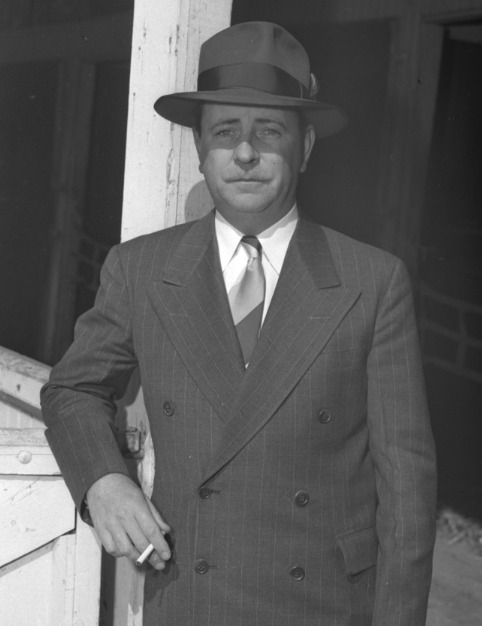
↗Thomas M. Rose · portrait published January 14, 1951. UK Libraries Special Collections, 1.06-101.15, collection 2004av001.
Tommy “Tootsie” Rose
Rose gave the restaurant its name, drawn from the New York Saratoga racetrack, according to Beverly Fortune’s 1978 account. His roughly four-year ownership established the identity; the owners and staff who followed made it endure.
Local businesses helped shape the room: L. M. Tucker supplied decoration, and Perry Lumber advertised its remodeling, lumber and millwork. A July 1951 ad announced the cocktail lounge, adding another reason to stay.
The proposed sale dispute of 1954 belongs in the documentary record. The paired court clippings are preserved in the collection, with their allegations and agreed dismissal explained together.
Twenty-four years of keeping the place recognizably Saratoga.
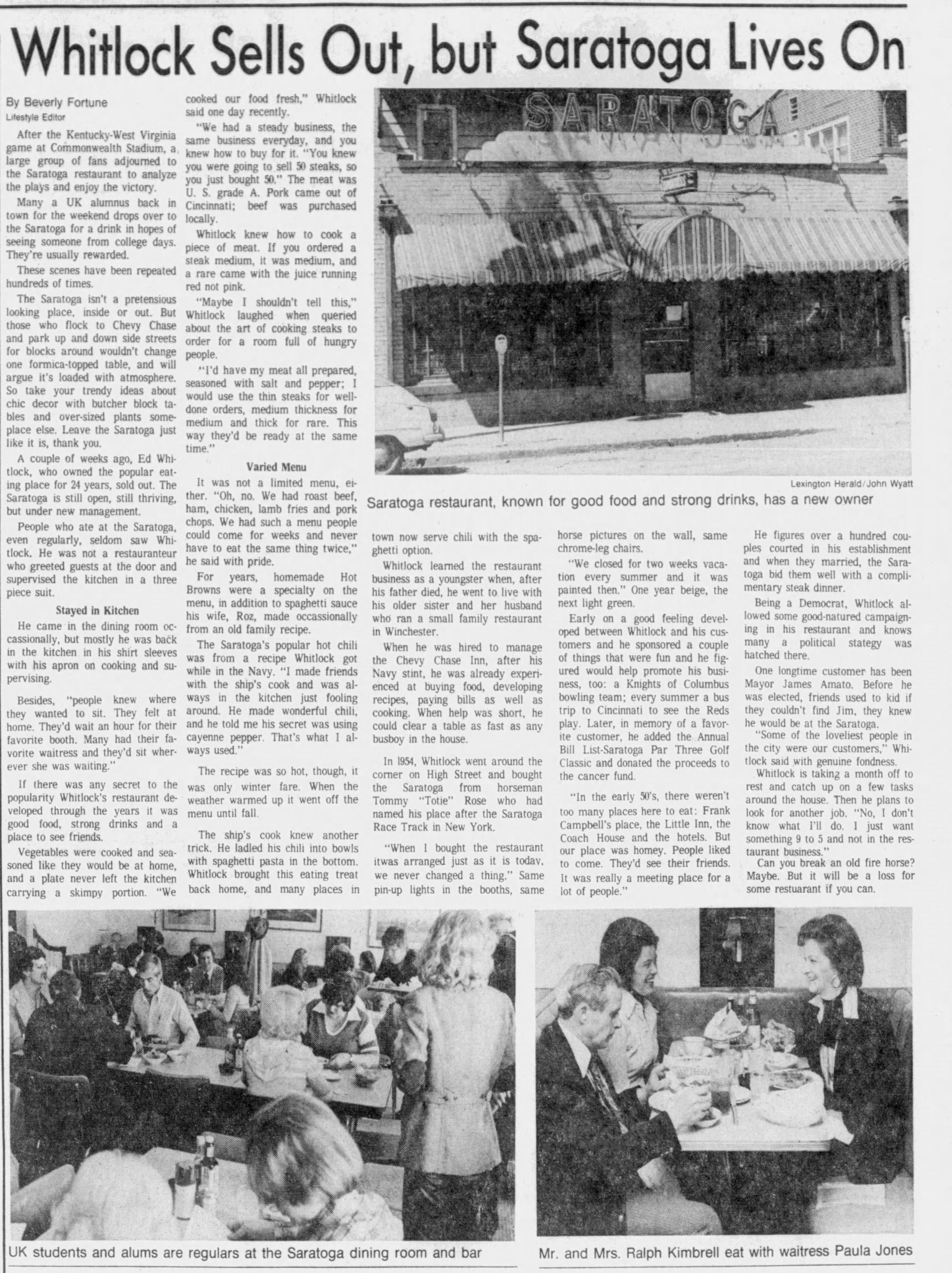
Ed Whitlock bought the restaurant from Rose in 1954. He had managed the nearby Chevy Chase Inn and understood cooking, food buying and the rhythm of a neighborhood restaurant. His contribution was continuity: keeping the name, building the food’s reputation and giving regulars a place they could recognize year after year.
“We never changed a thing.”
When Beverly Fortune interviewed Whitlock in 1978, he recalled inheriting the room in the arrangement it still had: booth lights, horse pictures and chrome-leg chairs. That familiarity became part of the attraction.
Whitlock had served in the Navy and gained earlier restaurant experience with his sister’s family in Winchester. Saratoga closed for two weeks each summer for vacation and repainting; maintaining the familiar room still took work.
His cooking gave the restaurant another kind of identity. Hot Browns, roast beef, lamb fries, pork chops and Navy-style cayenne chili joined a menu shaped by experience. His wife Roz’s spaghetti sauce was part of the story, too.
The 1974 Kentucky Kernel review found a crowded room and generous meals, most around $3.50. It also noted noise and slow service. Saratoga’s appeal survived those rough edges because people liked the food, the value and the company.
↗Beverly Fortune’s April 10, 1978 feature: the room, its regulars and the end of Whitlock’s twenty-four years.
JANUARY 1978 · THE HANDOVER TAKES SHAPE
A contract, a family and the same familiar staff.
Bette Pearce’s January 6 report describes a sale still in progress. Whitlock had signed a contract with building owners Ronald and Arlene Alter, who had agreed to pass the business to the Mims family. Whitlock still held the keys and said he had not yet received payment.
Ted Mims named four intended owners: himself, his wife Sandra, and his parents Joe and Elizabeth. Sandra and Elizabeth were to be equal managers. The promise was to retain the employees, bartender and home-style menu. By April, Beverly Fortune’s feature reported Whitlock’s completed sale.
The room kept its rhythm. The family carried it on.
Ted and Sandra Mims, together with Ted’s parents Wilburn “Joe” and Elizabeth “Liz” Mims, inherited more than a restaurant. They inherited everyone’s idea of what Saratoga ought to be.
The contemporary transfer reports place the Mims purchase in 1978 and the sale of the restaurant’s name and assets in February 1990. A later retrospective recalled 1977–1989; this timeline follows the reports published around the transactions.
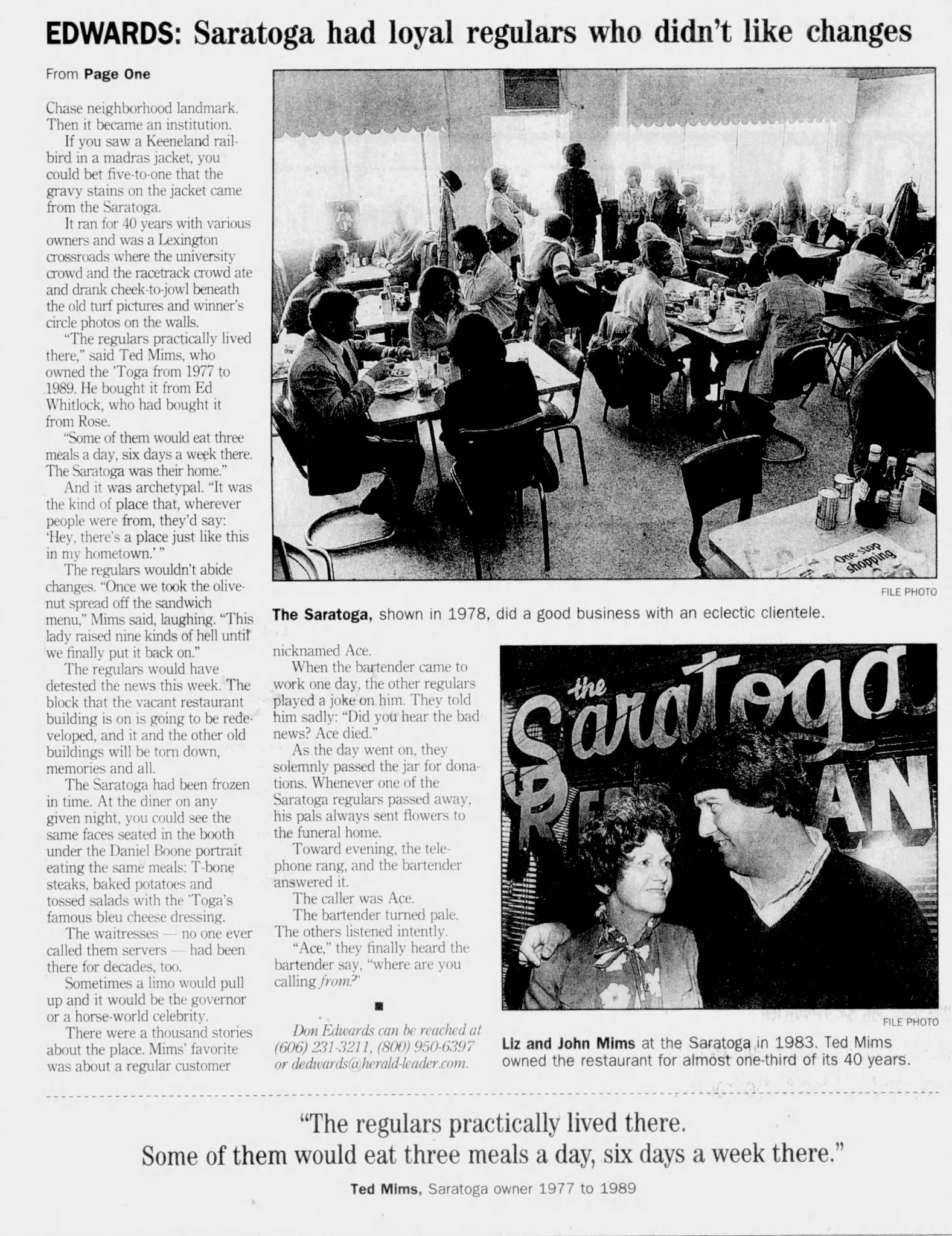
Mims remembered regulars who ate three meals a day, six days a week. For them, the restaurant was an extension of home. Removing olive-nut spread from the sandwich menu brought such an objection that it was restored.
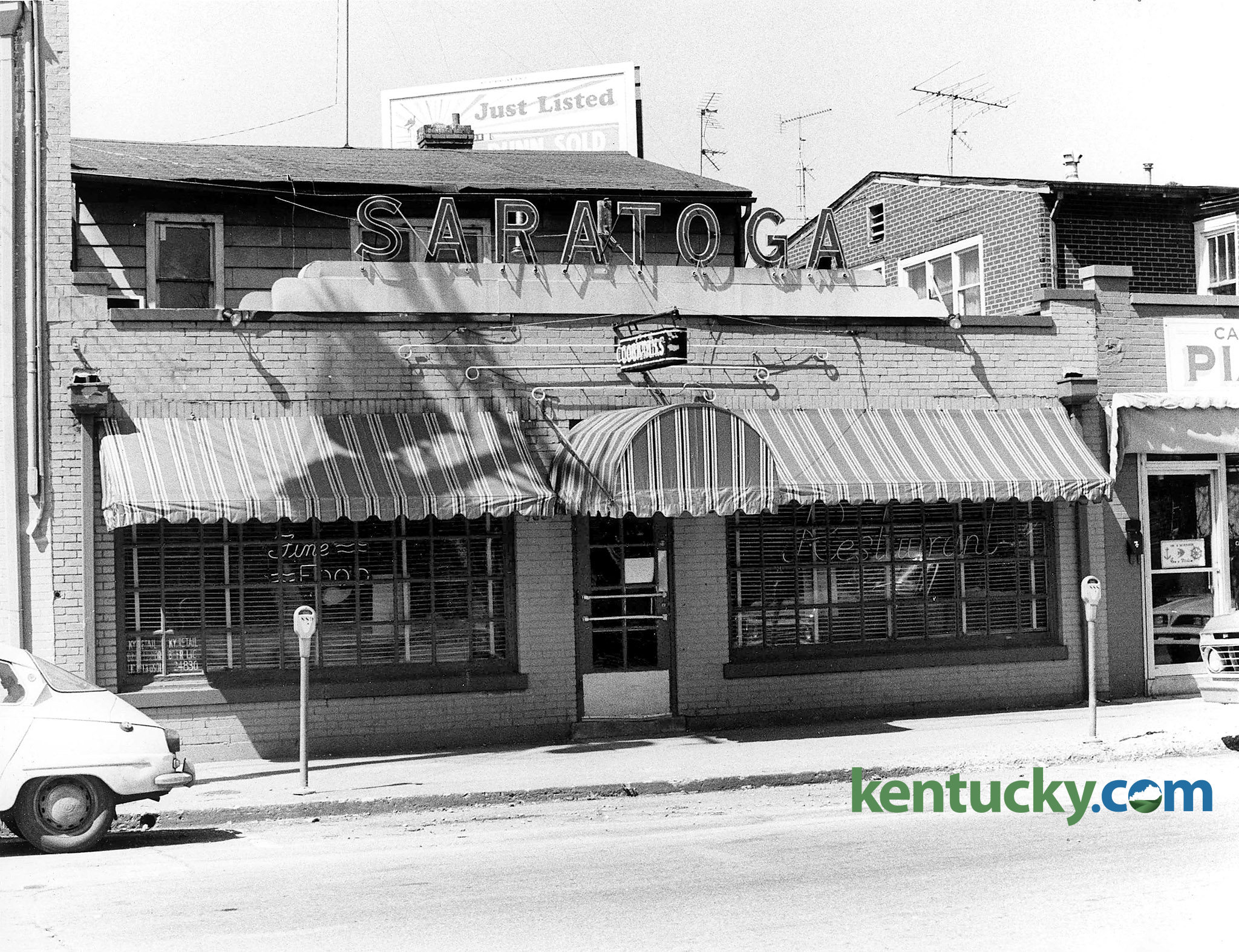
↗The familiar Saratoga frontage · April 10, 1978. John C. Wyatt / Lexington Herald-Leader.
THE FAMILY BEHIND THE NAME
A family business in every sense.
The 1978 sale announcement put Sandra and Elizabeth Mims at the center of daily management. Elizabeth brought experience from the Stirrup Cup and the Downtowner Motel. The January 1979 review described Ted running Saratoga with his wife and mother while preserving the familiar room and its longtime staff.
By November 1984, Johnny Mims was helping manage the restaurant. Elizabeth waited tables three days a week, cooked Saturdays, managed catering, tended to the vegetables and occasionally worked the bar. Merlene Davis’s two-part profile makes clear how much of Saratoga’s everyday operation passed through her hands.
Wilburn “Joe” Mims worked behind the scenes. In his February 1984 obituary, son Teddy J. Mims described his parents as daily operators and his father as an effective, quiet presence. The obituary also records the family’s second Saratoga in Richmond, opened about two months earlier.
Joe, an Army veteran of World War II and retired appliance salesman, volunteered with veterans and God’s Pantry. His son remembered him as a founder of St. Michael’s Episcopal Church. He died at 61; later that year, Elizabeth spoke about keeping busy while learning to live with his absence.
The food still mattered
The June 1986 review called Saratoga a place of enduring charms. Fried chicken, lamb fries, country ham and generously seasoned vegetables were part of its appeal. Pecan-breaded sole appeared as a Saturday-night special, alongside Roquefort dressing, stewed tomatoes, green beans and Harvard beets.
The later years were also work: holding on to customers as habits and the neighborhood changed. The Mims family deserves credit for sustaining a familiar institution through another generation.
The people in the room
University people, horse-world regulars, neighborhood customers and public figures shared the restaurant. Its atmosphere came from the mix, from familiar faces at familiar tables, and from staff who knew how the place worked.
Don Edwards’s 2000 retrospective preserves that memory beside a photograph of Liz and John Mims at Saratoga in 1983. The full page is available here, with both photographs and the continuing story intact.
The sign brought people to the door. The people inside gave them a reason to return.
Saratoga’s forty-five-year story belongs to its staff as much as its owners. The servers carried the room’s memory from one ownership to the next; the kitchen and bar made familiar meals and familiar evenings possible.
Longtime employees Mary and Sarah deserve their own place in that history. Newspaper reports document Mary Price’s years of service; Sarah’s surname, working dates and personal stories will be added with the firsthand material Kevin is gathering.
The dining room, April 1978 · John C. Wyatt / Herald-Leader
INSIDE THE ’TOGA
The room was the occasion.
Look closely: coats on stands, conversation across small tables, a server moving through a full room. John C. Wyatt’s photograph preserves an ordinary moment that now feels irreplaceable.
“The Saratoga was its characters.”
Don Edwards, recalled in the Herald-Leader’s 2022 retrospective.[2]
MARY PRICE · AT SARATOGA FROM 1958
From serving the room to bringing it back.
The July 1992 reopening report says Mary Price had worked at Saratoga since 1958. She and Jim Croley reopened the restaurant on July 17 after its liquor-license closure, promising continuity in the menu and prices.
By 1993 they were making a memorable promise: lunch in fifteen minutes after the order was rung—or half off the ticket. In 1994, Price described home cooking as central to what belonged at Saratoga.
SARAH · A FAMILIAR FACE
A place in the restaurant’s memory.
Kevin remembers Sarah among the longtime servers who helped make Saratoga special. This space is reserved for her photograph and the stories that put a voice, a personality and a working life beside her name.
Surname and years of service to be confirmed through photographs and recollections.
ONE STORY · TWO CONNECTED PAGES · NOVEMBER 12, 1984
Hard work, family and a sense of humor.
Merlene Davis’s profile begins with Liz’s childhood and kitchen photograph on C1, then continues on C2 with her marriage, five children, years of restaurant work and the family’s 1978 purchase. Ted, Clifford, Teresa, Johnny and Kimberly all appear in the account. Both original pages are kept together here.
The continuation also captures her grief after Wilburn’s death that February and her determination to stay busy. The unrelated home-loan article alongside it is preserved in the scan but is separate from Liz’s story.
The date follows the supplied filenames. The printed C1/C2 page labels are established by the newspaper’s continuation directions. Each full-size viewer links directly to the other part.
MORE NAMES RETURN TO THE RECORD
Jim, Paula, Everett, Mrs. Morgan—and the people still to be named.
Jim Sweitzer, the bartender interviewed in January 1979, had served at Saratoga for twenty-six years according to that review. Ted Mims described the generous drinks as part of the restaurant’s tradition. The reviewer’s two daiquiris arrived with noticeably different strengths—a reminder that the room’s personality came through even in its pours.
The 1978 photo captions identify waitress Paula Jones with diners Mr. and Mrs. Ralph Kimbrell. An earlier theft report records Everett Maupin, the janitor who found the money sacks, and Mrs. M. B. Morgan, the bookkeeper who checked the loss. These small details put working people back into the history.
Earlier Reynolds directory research also recorded Marie Clay, cook; Louis Newby, porter; and Burt Roland, clerk. The address had a working community long before the Saratoga Restaurant name.
A SMALL NOTICE OF EVERYDAY WORK · 1973
Behind every plate, someone’s work.
A September 1973 classified sought a “salad woman” at 856 East High Street. The brief notice names no employee, but it preserves another role in the kitchen that helped keep the restaurant running.
A place remembered for strong drinks also had a kitchen people came back for.
The dated menus now put detail behind that memory. In 1950 Saratoga served prime rib, country ham, fried chicken with cream gravy, turkey with oyster dressing, veal, pork, shrimp, scallops and perch. Under Ed Whitlock, Hot Browns, Navy-style cayenne chili, roast beef, lamb fries, pork chops and his wife Roz’s spaghetti sauce became part of the story. The 1986 review adds pecan-breaded sole, Roquefort dressing, stewed tomatoes, bacon-seasoned green beans and Harvard beets.
Meatloaf, chicken and dumplings, salmon croquettes and olive-nut spread belonged to the later plate-lunch repertoire.[2]
The sandwich they wouldn’t let go
When olive-nut spread disappeared from the menu, a regular pressed Mims to bring it back. Cookbook author Barbara Harper Bach later obtained a version of the recipe from a former waitress, preserving another small piece of the restaurant.[2]
Historical items and prices reported by Kentucky Photo Archive.[1] Typeset from the published historical account; the original menu scan has not yet been located. The menu’s date is not specified.
A TABLE FOR THE KENTUCKY KERNEL
NOVEMBER 25, 1974 · PAGES 4–5
The $3.50 dinner with almost everything.
Soup or juice. A salad choice. Potatoes. Vegetables. An entrée. Coffee or tea. The student newspaper thought the prices were almost unreasonable—in the customer’s favor.
In his Gastro-gnome review, Tom Moore reported that most dinners cost $3.50, with complete meals ranging from $2 to $6.75 including tax. He tried chopped sirloin with mushroom sauce, parsley potatoes, turnip greens, salad and vegetable soup, then added a hot roast beef sandwich.
The menu ranged through roast beef, turkey, fried liver, pork chops, Virginia ham, chicken à la king and lamb fries. The continuation lists 25 sandwich combinations at 55¢–$1.50, including olive nut and sardine and onion. Rainbow trout was $3.75; lobster tails, $6.75.
Moore praised the portions and value, while noting the room’s noise and sometimes slow service. The food was worth waiting for; waiting could indeed be part of the experience.
The issue date appears on both pages. Other ads and photographs on these pages are separate from the Saratoga Restaurant review.
THE SUNDAY INVITATION
A dollar fifty, and dinner was settled.
A contributed ad labeled 1952 offers complete Sunday dinners from $1.50, with service from noon until 9 p.m. The address is printed twice: 856 East High Street.
An ad labeled 1961 invites patrons to watch Macy’s Thanksgiving Day Parade at Saratoga Restaurant. Its big selling point sits right at the top: “IN COLOR.”
A program page labeled 1982 carries a Saratoga Club advertisement beside UK sports promotions. It claims a Bluegrass tradition of 25 years—a piece of the restaurant’s self-image, with its dating still to be verified.
JANUARY 11, 1979 · JOHN WOESTENDIEK · THE LEXINGTON LEADER
The same room, with a little more room.
A year into the Mims era, the restaurant had added a room and grown from 85 to 117 seats. Reservations were not taken. John Woestendiek found the familiar Formica tables, straight-backed chairs, booth lamps, horse pictures and loyal neighborhood trade still in place.
He praised a tender, well-cooked T-bone and the value of the hot roast-beef sandwich, while finding the fries ordinary, green beans bland and service uneven. Mims said the food was prepared fresh daily, largely by the same longtime hands, and kitchen improvements were intended to speed service.
Prices recorded in the January 1979 review
From the menu
Price
Large T-bone, vegetable, rolls and coffee or tea
$8.50
Hot roast-beef sandwich with french fries
$2.45
Liver and onions; chopped sirloin; lamb fries; half a fried chicken; or breaded pork chops
$4.75 each
French-fried shrimp / rainbow trout
$5.25 / $5.75
Lobster tail / filet of sole or cod
$10.95 / $4.75
Egg sandwich / club sandwich
95¢ / $2.35
The baked-potato calendar: Tuesdays, Thursdays, Fridays and Saturdays. Mims explained that without a microwave they had been left with cold potatoes at closing; a microwave was on the wish list. Fried mushrooms and onion rings were recent additions.
Food service began at 7:30 a.m., ending at 10 p.m. Monday–Thursday and 11 p.m. Friday–Saturday; the bar stayed open until 1 a.m. on operating nights. Saratoga was closed Sundays. These are the hours and prices of January 1979.
These are documented meals and specials from different years, rather than a reconstructed weekly menu. Historical prices belong to the dated advertisements.
07 / STORIES OF THE SARATOGA
STRAIGHT FROM THE NEWSPAPER FILE
↗The original report. Open the clipping to enlarge it or read the article text.
A COURTROOM CLASSIC
Five bucks for the pain. No word on the ketchup.
One damaged tooth. One overturned table. One ketchup bottle that picked the wrong evening.
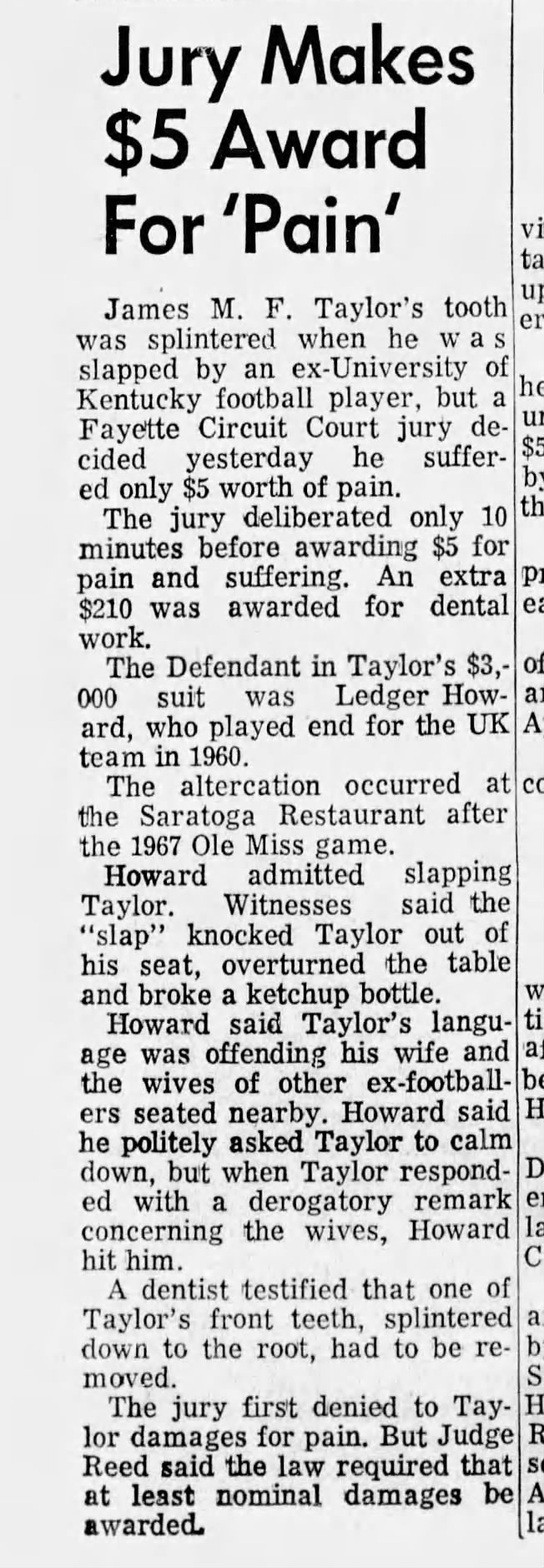
The newspaper’s own headline was almost impossible to improve: “Jury Makes $5 Award For ‘Pain’.” James M. F. Taylor had sued former UK football player Ledger Howard for $3,000 after an altercation at Saratoga Restaurant.
Howard admitted slapping Taylor. He said Taylor’s language had offended his wife and other players’ wives nearby. According to Howard’s account, a request to calm down brought another derogatory remark about the wives—and then the slap.
Witnesses described something rather larger than the word slap suggests: Taylor was knocked out of his seat, the table overturned, and a ketchup bottle broke. A dentist testified that a front tooth had split to the root and needed removal.
$3,000CLAIM FILED
$5PAIN & SUFFERING
$210DENTAL WORK
The jury deliberated for ten minutes. The report says jurors initially awarded nothing for pain until Judge Reed directed that nominal damages be allowed. The final total was $215. The ketchup bottle received no mention in the award.
The report places the incident after the 1967 Ole Miss game. Its publication date is not visible, and it does not identify Taylor’s team allegiance. The headline above is this archive’s playful retelling.
TED MIMS’S FAVORITE · RECORDED BY DON EDWARDS, 2000
Ace was dead. Then the telephone rang.
The regulars told the bartender a customer nicknamed Ace had died. All day they solemnly passed a jar for donations, just as they did when sending flowers after a friend’s death.
Toward evening, the telephone rang. It was Ace. The bartender turned pale while everyone waited for his response: “Ace, where are you calling from?”
LIZ’S CHILDHOOD RECOLLECTION · TOLD TO MERLENE DAVIS, 1984
The banana stand that needed an audience.
Liz recalled that her father set her up selling bananas outside the family restaurant to nearby tobacco-warehouse workers. When business was slow, she said, she made a false fire report to bring the workers outside. They bought the bananas, and her father had to fetch another stalk.
The profile presents this as her own childhood anecdote, the beginning of a mischievous streak that restaurateur Larry Ellington still recognized decades later. If a moment grew quiet, he said, Liz would find something to get started.
Charlie Fite was remembered. The legend needed correcting.
The 1979 review found musician and regular Charlie Fite’s name engraved in the bar. Ted Mims remembered someone the clientele liked, but expressly denied the story that Fite had died there. The anecdote belongs in Saratoga’s folklore with that correction attached.
One report put the missing cash at about $420. Detectives said the checks and $61.40 in coins were still there. Even the theft had its own peculiar accounting.
Labeled 1952 by the contributor; the issue date is not visible.
NOVEMBER 1962 · THREE NEIGHBORING BUSINESSES
A long night on East High Street.
Police investigated break-ins at Saratoga, The Merry Aquarium and Greenwald’s Delicatessen. Ed Whitlock reported about $200 missing from two vending machines, plus food and liquor. Patrolman Frank Fryman discovered Saratoga Restaurant break-in around 4:20 a.m. Sunday.
The clipping reports the investigation and alleged losses; it supplies no later case outcome.
A SEPARATE, UNDATED REPORT
A takeaway order nobody approved.
Another clipping reports about $100 in whisky and $60 in change stolen after a rear-door break-in. The change came from three vending machines. This was an unusually literal case of helping oneself.
Saratoga Restaurant’s name also appeared in Lexington’s recreational life. A surviving clipping reports its team leading the 25th annual Lexington City bowling tournament.
“Saratoga Takes Early Lead As City Bowling Meet Begins”
3,058
SARATOGA’S LEADING TEAM SCORE
Whitlock’s community life extended to Knights of Columbus bowling, annual bus trips to Cincinnati Reds games, and the Bill List–Saratoga Par Three Golf Classic benefiting a cancer fund. The 1978 feature records these traditions alongside his restaurant work.
Liz carried the sporting tradition forward. A July 1987 notice announced the Saratoga Golf Tournament’s sixteenth year, benefiting Cardinal Hill Hospital under her sponsorship. Play was scheduled for 8 a.m. at Meadowbrook Golf Course, with $15 public tickets; the auction and lunch afterward were at the Little Inn on Winchester Road. This is a separately documented event from Whitlock’s cancer-fund tournament.
The 1954 proposed-sale dispute and the 1956–1957 Plarr litigation also passed through Saratoga’s news record. The sale reports are paired with the agreed dismissal; the later courtroom clippings preserve competing testimony. They are included as period reporting, with allegations distinguished from findings.
The restaurant’s final closing came in 1995. The building remained for another five years—long enough for Lexington to watch, wait and remember.
The years between the Mims family and the final closing were complicated. The clippings preserve purchases, subleases, a brief shutdown, a staff-led reopening and a redevelopment plan that stalled before the old building finally came down.
February 16, 1990
The name and assets change hands
S.R. Holding Co., owned by Charlotte and Michael Lundergan, bought the name and restaurant assets from the Mims family. The February 27 report says the land and building were not included.
June–August 1990
A closure, then the Ramsey/Reilly reopening
The December 29 report says Charlotte Lundergan closed Saratoga in June, then leased it to Rob Ramsey and Jay Reilly, co-owners of Ramsey’s Diner. They reopened in late August.
October 4, 1990
A dispute after the Mims sale
Elizabeth Mims sued Charlotte Lundergan and S.R. Holding Co. over allegedly missed payments on a $25,000 promissory note. The holding company’s attorney called the suit without merit. The clipping reports no outcome; the note is not identified as the restaurant’s full purchase price.
December 22, 1990
The doors close again
Ramsey and Reilly declined to renew their option, and Saratoga closed for the second time that year. Jerry Lundergan said an agreement with an unnamed national restaurant company was near. The report does not establish that the proposed deal was completed.
1991–1992
Transfers, liabilities and a temporary closure
The July 1992 account traces an agreement with Jim Croley, Tony Seta, Elizabeth Nelson and Sam Nelson, followed by a transfer of stock to Jim McKinney. It reports disputed liabilities, repossession and a suit alleging unpaid purchase money. These business claims remain attributed to the contemporary report.
July 17, 1992
Mary Price and Jim Croley reopen
After the June 30 liquor-license closure, Price & Associates returned Saratoga to service. The lease described 856 and 858 East High. For longtime employee Mary Price, this was a chance to preserve the place she had served since 1958.
Summer 1995
The final closing
The restaurant closed for good. The 1997 reporting and the February 2000 retrospective both look back on that 1995 closing; it was distinct from the earlier temporary shutdowns.
July 1997
A redevelopment plan on hold
A sign on the door had promised a two-week closure; two years later, the doors were still shut. Growth Properties’ wider redevelopment plan was stalled while adjoining property purchases remained unresolved. Florist John Oram wished to keep his property, and Bill Farmer Jr. wanted better upkeep of the vacant buildings. The article preserves both the developer’s plan and the neighboring merchants’ objections.
February 3, 2000
The last winter
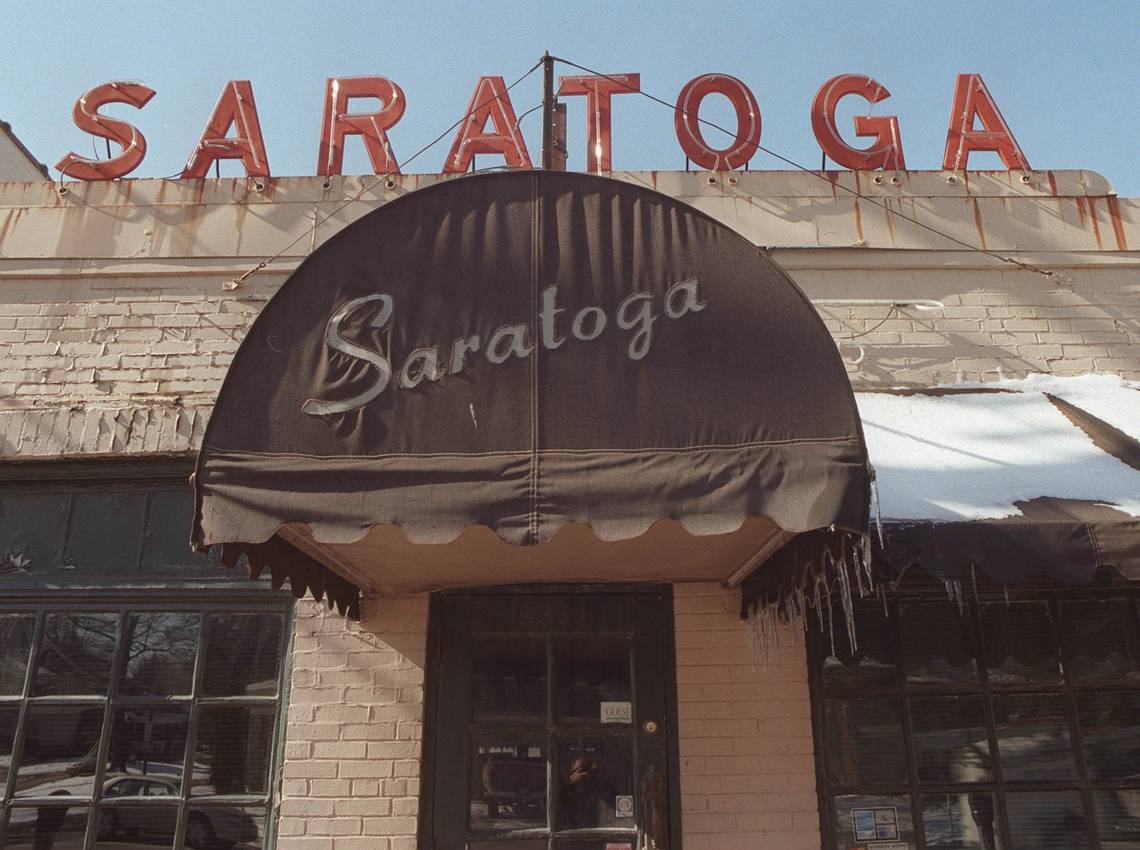
The newspaper described the coming demolition and planned replacement with stores and offices. The old sign and awning still stood as former owners, staff and customers remembered the restaurant.
May 12, 2000
Demolition day
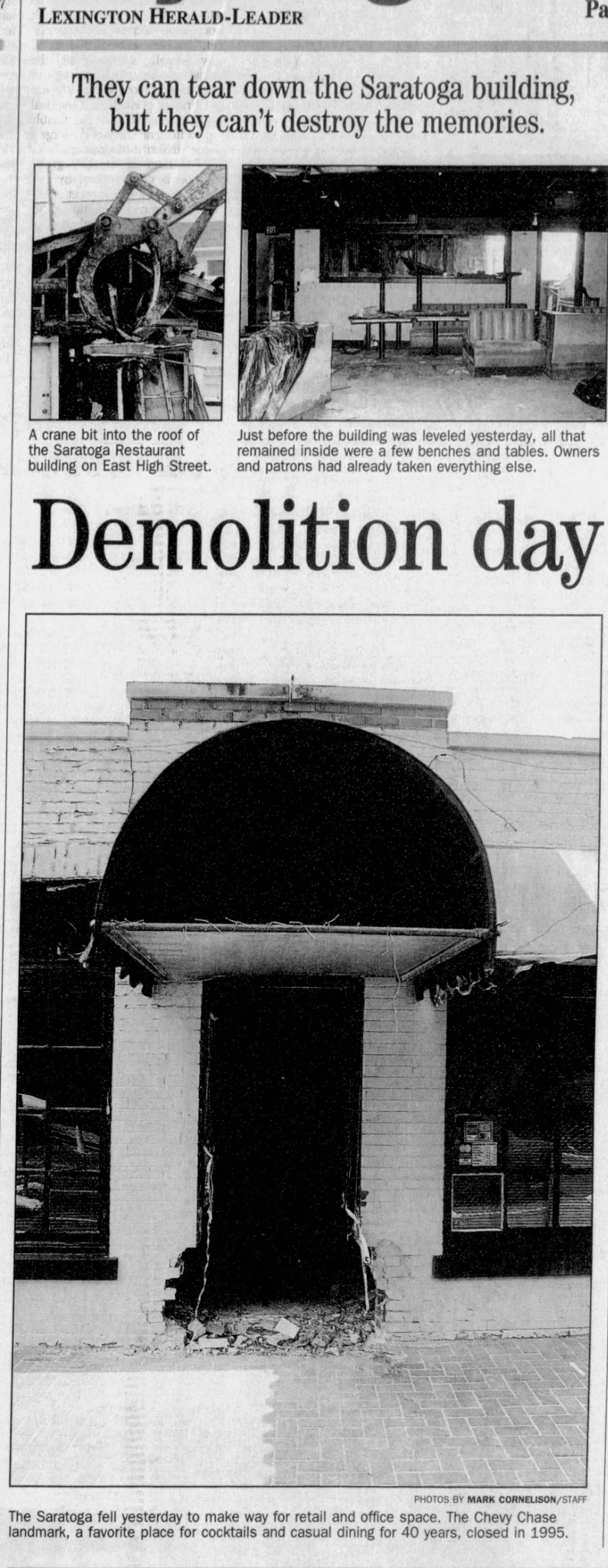
Machinery tore into the roof, and the building came down. Mark Cornelison’s photographs preserve its nearly empty dining room and damaged entrance. The May 13 newspaper clipping says Saratoga Restaurant fell “yesterday,” placing demolition on May 12. Read the report and its date notes ↗
August 6, 2000
The pictures outlast the building
The newspaper’s arts column described the former restaurant site as a temporary parking lot. Steve Elswick’s signed prints preserved a place the city could no longer visit.
Names and dates in the ownership record
The December 1990 report dates the Ramsey/Reilly operation to late August–December 22 and calls them lessees. It names Jay Reilly; the later Kentucky Photo Archive account uses Joe Reilly. The timeline follows the contemporary report while retaining the later account as a separate source.
Parking was already on the agenda at business-association meetings at Saratoga in 1950. The October report counted eighty employees’ cars occupying spaces. Decades later, the attraction of easier parking and access elsewhere put older neighborhood businesses at a disadvantage.
Kevin McCloud regards limited parking as one of Saratoga’s largest long-term problems. It is an important interpretation of the restaurant’s decline, alongside the ownership and business difficulties documented in the clippings. The record does not isolate a single cause of the final closing.
↗Charles Bertram’s photograph · February 2, 2000. The old sign and snow-covered awning still stood.↗Demolition at 856 East High · May 12, 2000. Mark Cornelison / Staff, Lexington Herald-Leader. Published May 13, according to the supplied newspaper date. Open the clipping to view all three photographs and captions.
“They can tear down the Saratoga building, but they can’t destroy the memories.” The clipping’s headline gives the building’s final day its fitting epitaph. The issue date comes from the contributor’s file; two captions say demolition happened the previous day. View the original and read the source notes ↗
Read the small summary, then open the original. Each exhibit has a full-size viewer, source notes and links to related pages where an article continues.
Repeated uploads of an identical scan share one exhibit. Different newspaper placements and article continuations are shown separately. Dates from supplied filenames are identified in the exhibit notes.
The Mims family · Work, food and community
Start with Merlene Davis’s connected C1–C2 profile of Elizabeth Mims, then follow the family’s purchase, daily operation and community life.
February 2, 2000 · Charles Bertram / Herald-Leader
The building left. The legend stayed.
A restaurant building had stood here since at least 1937. The Saratoga Restaurant name arrived in 1950 and lasted across forty-five years of meals, friendships and familiar faces. Rose began it; Whitlock built its staying power; the Mims family carried it onward; and staff like Mary Price kept fighting for another chapter.
Michael McLaughlin saved the original rooftop sign during this final chapter. He preserved it until Kevin McCloud purchased it in 2013, keeping one of the most recognizable physical pieces of Saratoga Restaurant intact. Follow the sign’s story →
The replacement development, known as Saratoga Center, hosted a succession of businesses. These occupied the redeveloped site; they were not continuations of the original restaurant.[5]
The address after Saratoga +
2001–2002
Roy’s East High Diner
2003–2011
Buddy’s Bar and Grill
2012–2014
Glenn’s Creek Brewery & Beer Exchange
Late 2015
The Macho Nacho; closed three months later
2016–2019
Louie’s Wine Dive
Fall 2020
Keller Williams Bluegrass Realty moves in
Chronology reported by Kathie Stamps in July 2021.[5] This is a historical record, not a current business directory.
THE ORIGINAL SIGN · THE NEXT CHAPTER
A Lexington tradition, carried forward.
Kevin had worked as a dishwasher at Saratoga, Little Inn and Upstairs Charlie Brown’s. The saved sign gives that personal connection a physical form. Its restoration and the planned Distillery District venue have their own story.
Restoration concept illustration · planned Distillery District venue.
THE READING ROOM
The record behind the memories.
This is an independent digital archive of the original Lexington restaurant. Dates, photographs and recollections are labeled so that each can be read in context.
Still sought: R&S’s owners and initials; the exact construction date; more Whitlock and Mims family photographs; Sarah’s surname and working dates; staff and customer recollections. Clearly marked spaces in the chapters show where those memories belong.
Reading the evidence
The collection preserves original scans, including conflicting dates and address variants. Contemporary 1950 opening ads take precedence over later 1953 recollections; contemporary 1978 and 1990 reports anchor the Mims timeline. Kevin’s memories and interpretations are identified separately.
Original credits and watermarks are retained. The 1937 AI image is an interpretation, shown with its source. Research edition · September 2026.
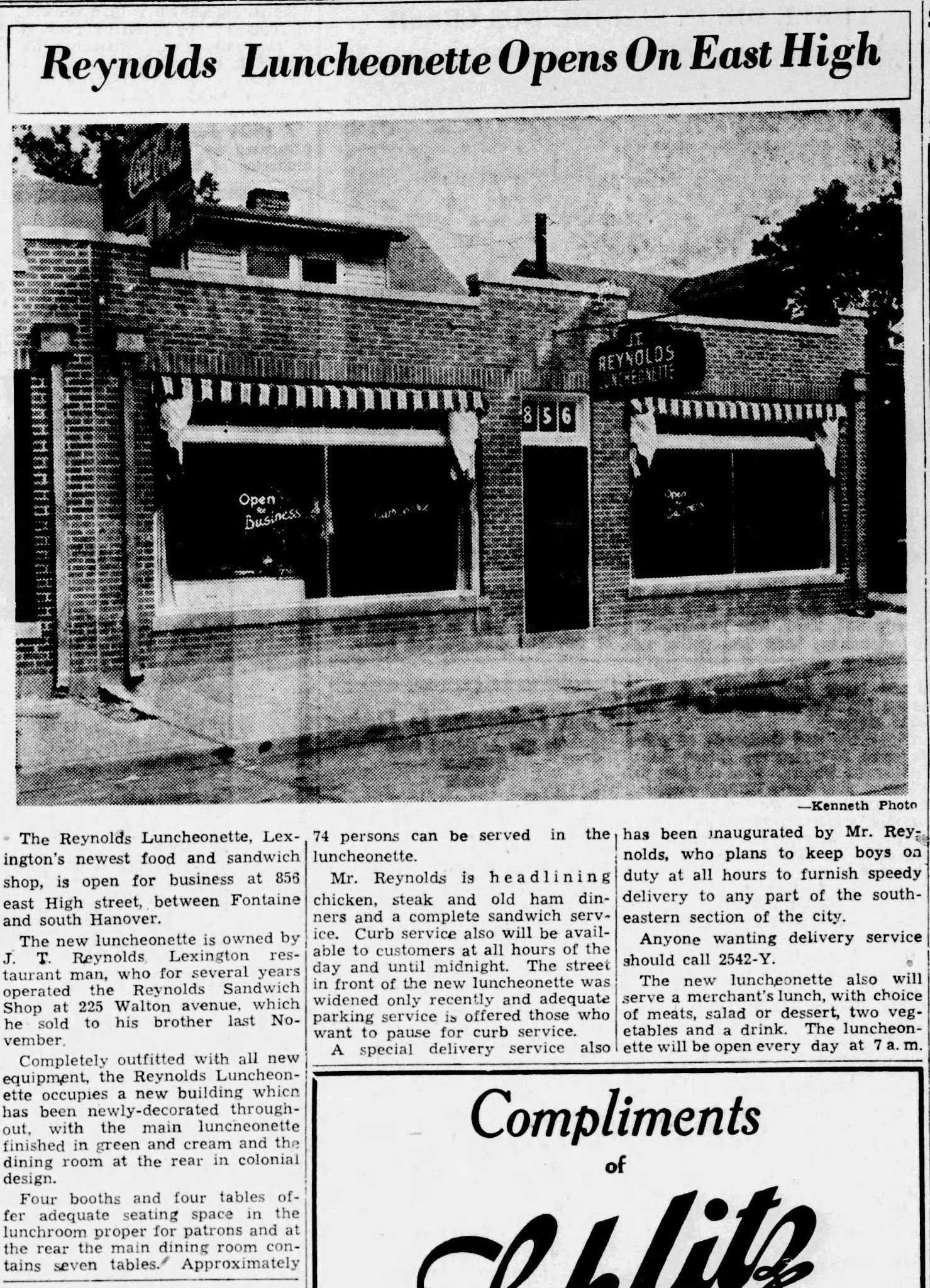 The future Saratoga, newly openedThe earliest known photograph of the future Saratoga at 856 East High Street.
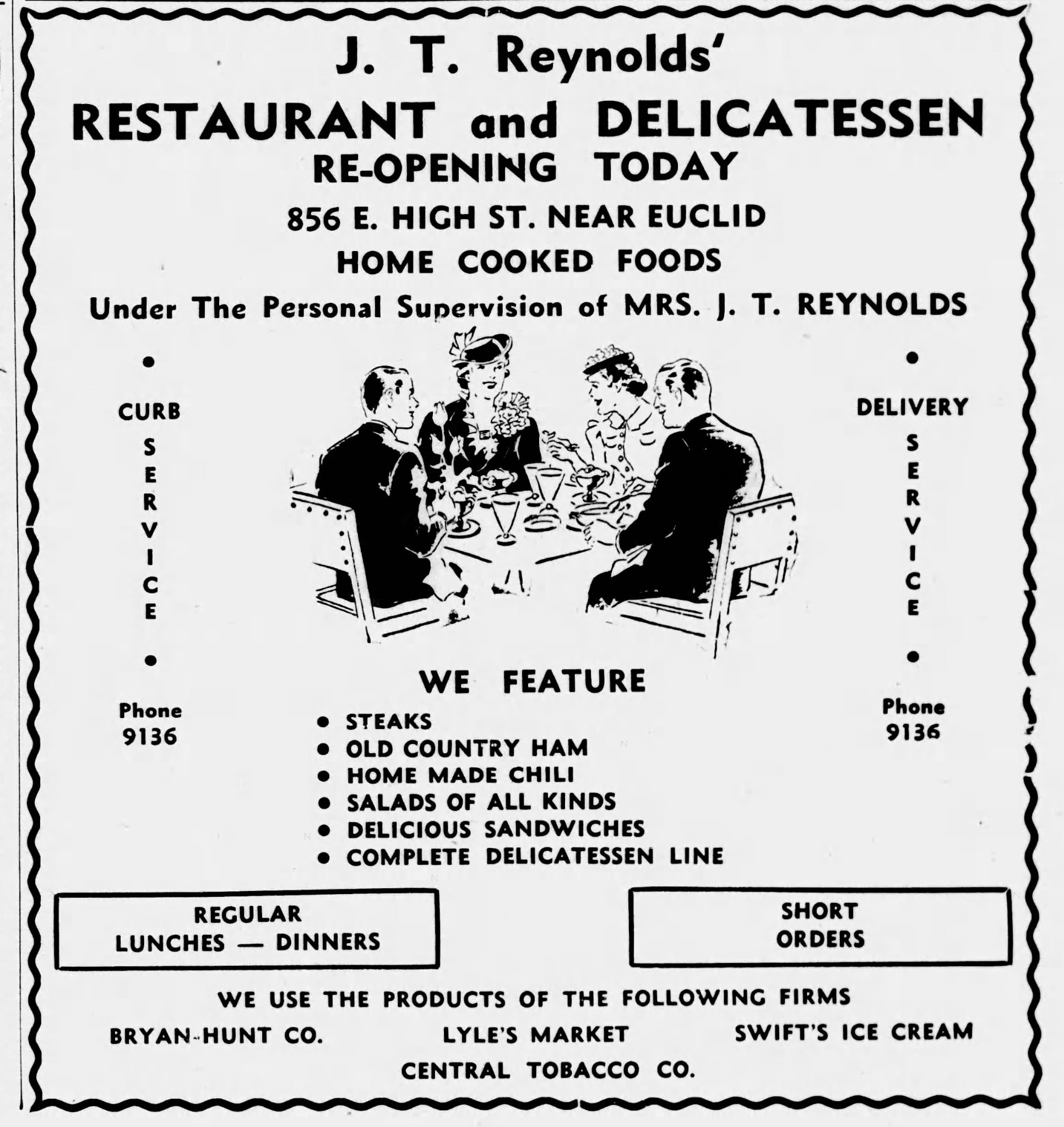 Home cooking under Mrs. ReynoldsReopening at 856 East High, with home cooking supervised by Mrs. Reynolds, a delicatessen, curb service and delivery.
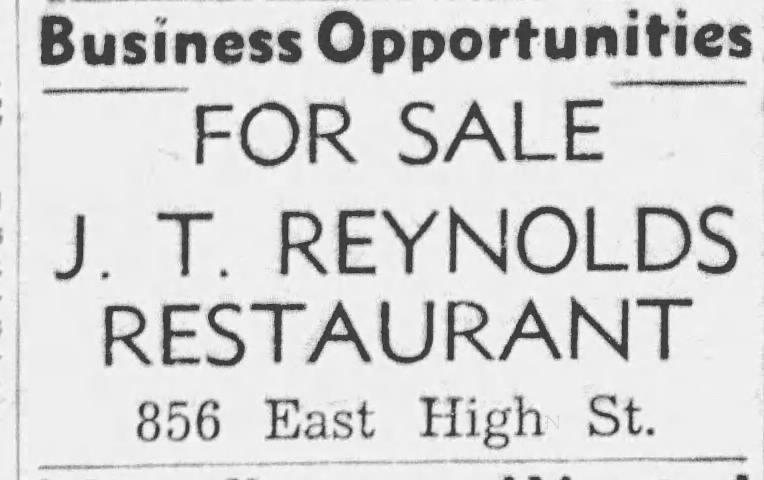 For sale: J. T. Reynolds RestaurantThe restaurant at 856 East High is offered for sale. No buyer, price or reason is given.
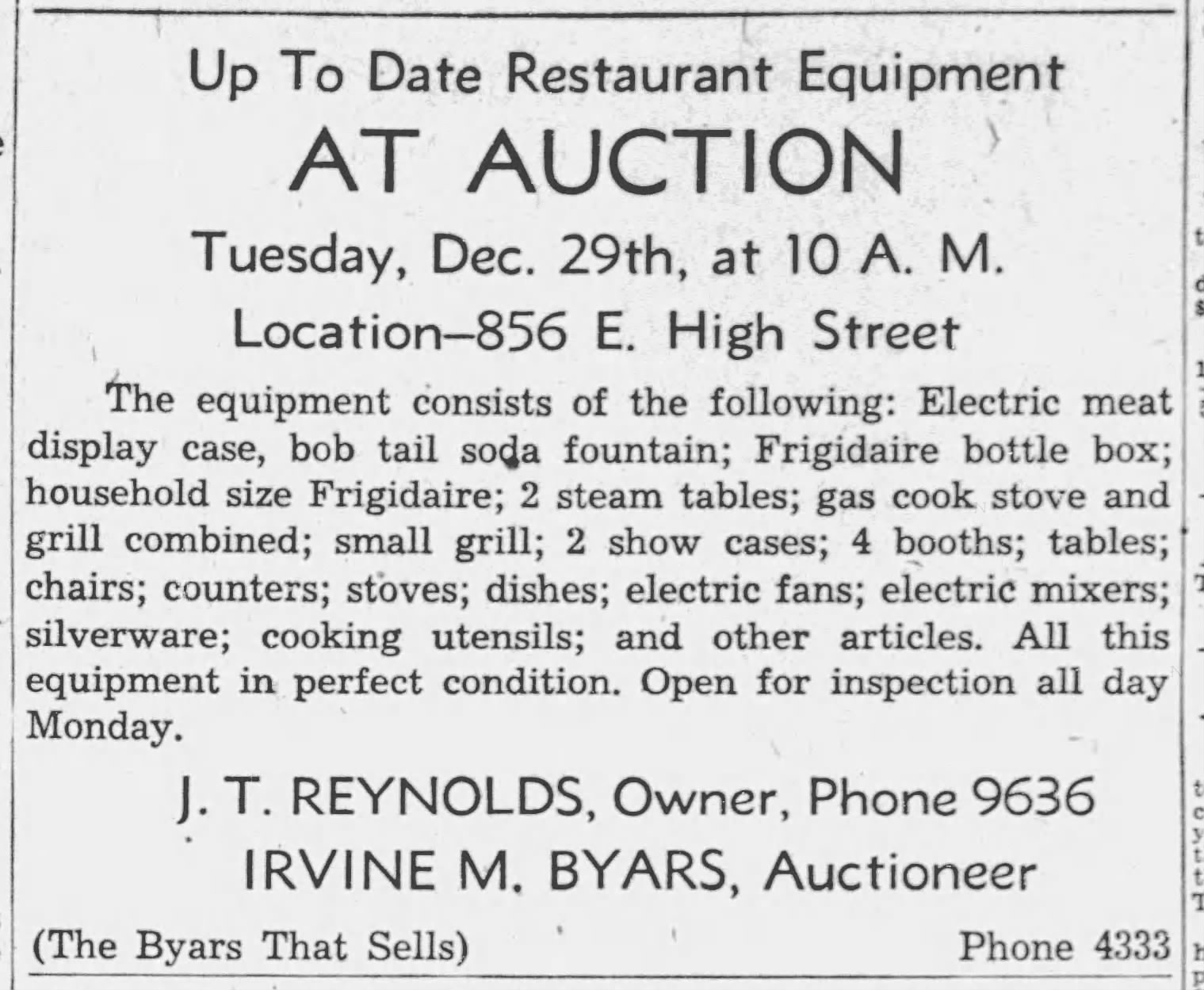 An auction of the restaurant’s equipmentAn auction is announced for Tuesday, December 29 at 10 a.m., at 856 East High.
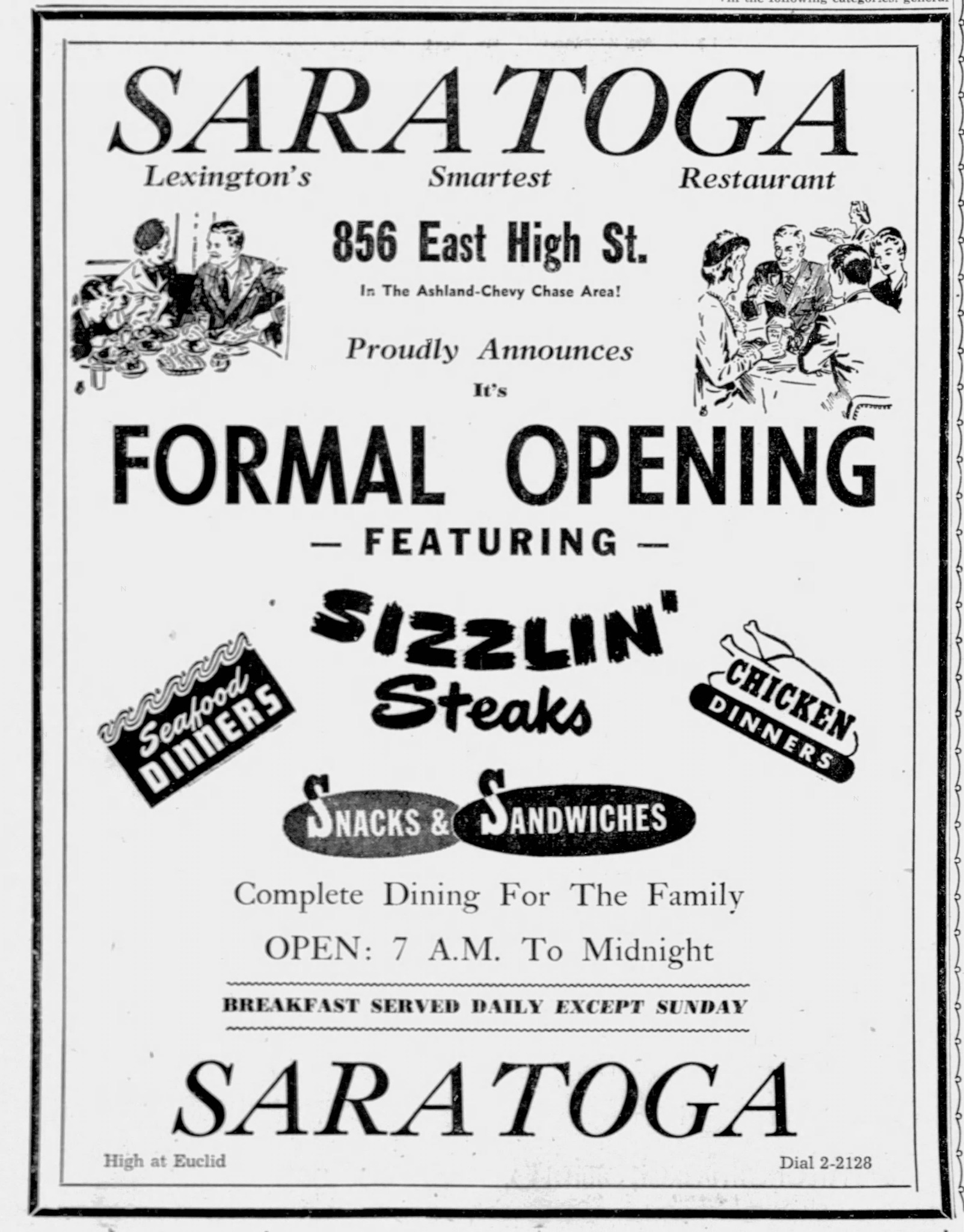
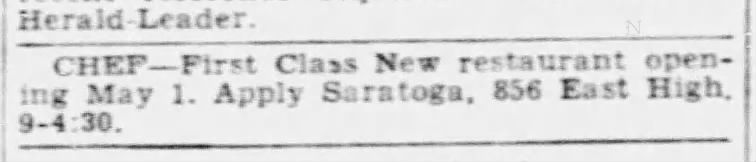 Chef wanted. Opening May 1.This classified seeks a first-class chef for a new restaurant scheduled to open May 1, directing applicants to Saratoga at 856 East High. Alongside the formal-opening advertisement, it provides contemporary evidence for the 1950 beginning.
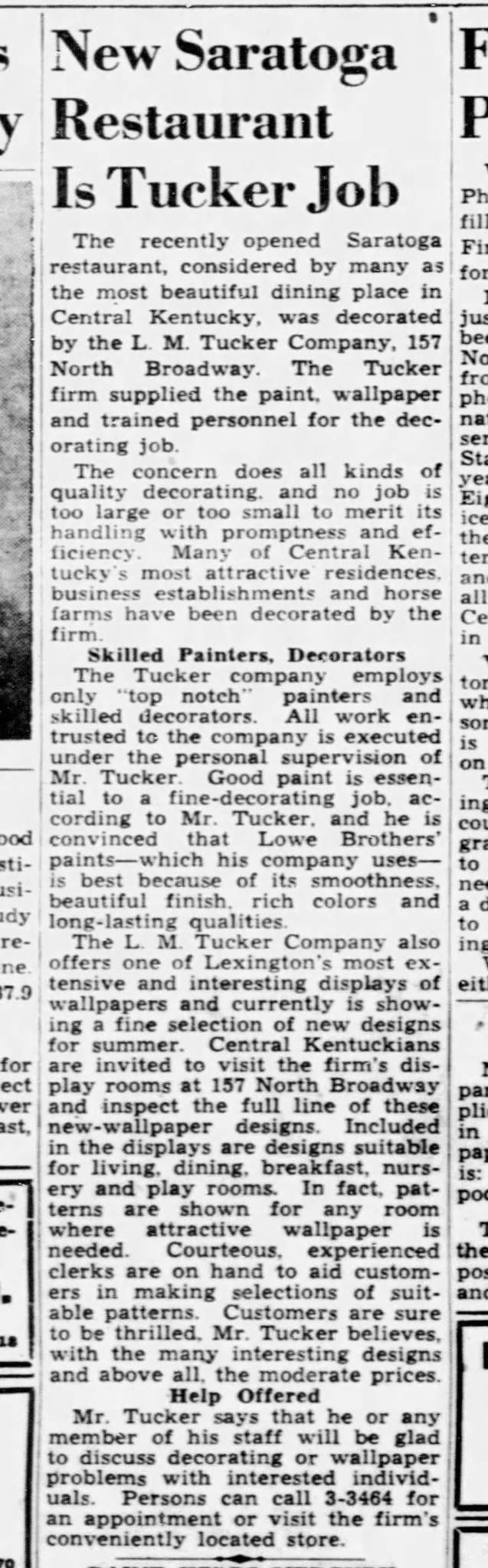 Before the characters, the decorators.L. M. Tucker supplied the paint, wallpaper and decorating crew.
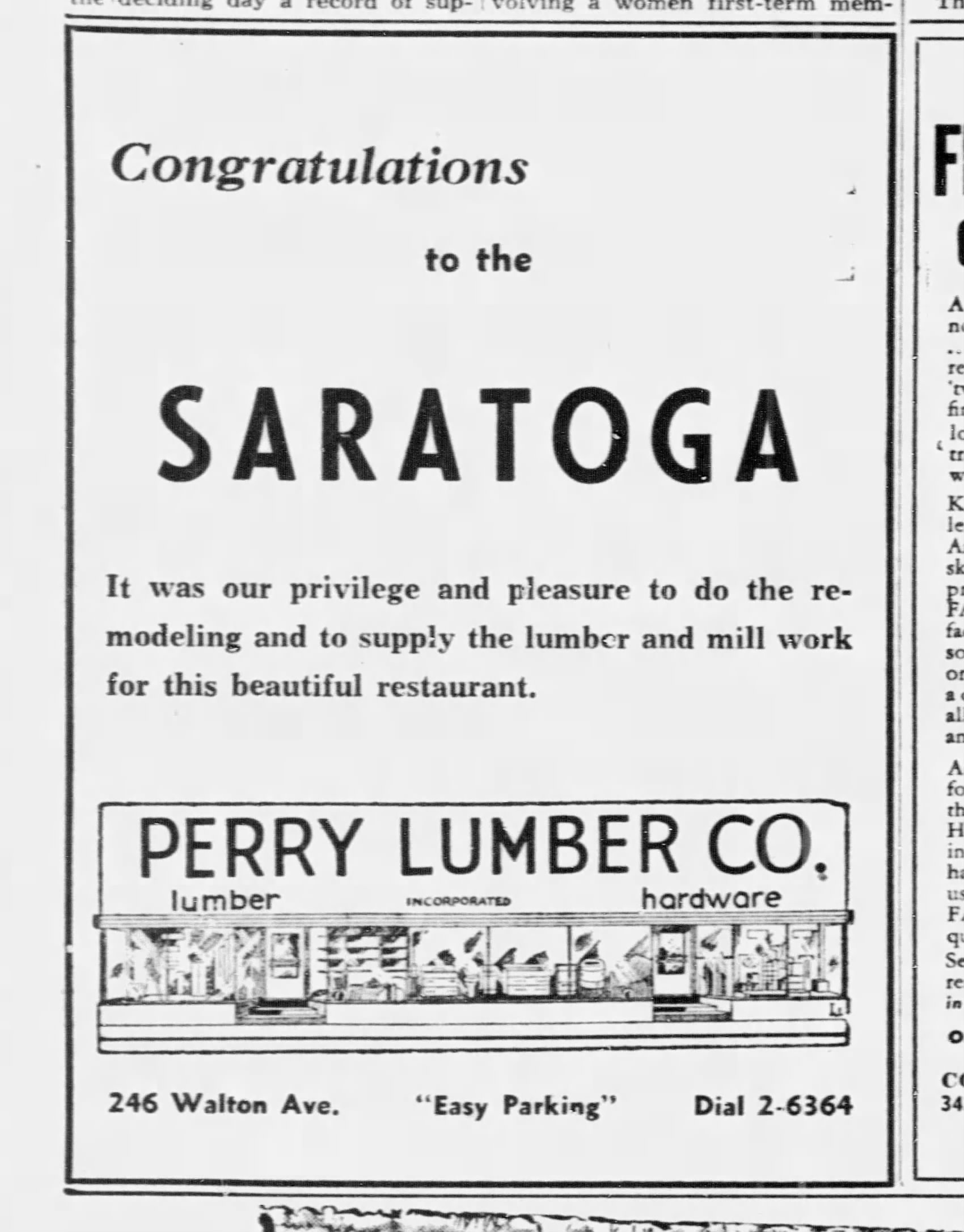 The lumber behind the landmarkPerry Lumber congratulates Saratoga Restaurant on its finished restaurant.
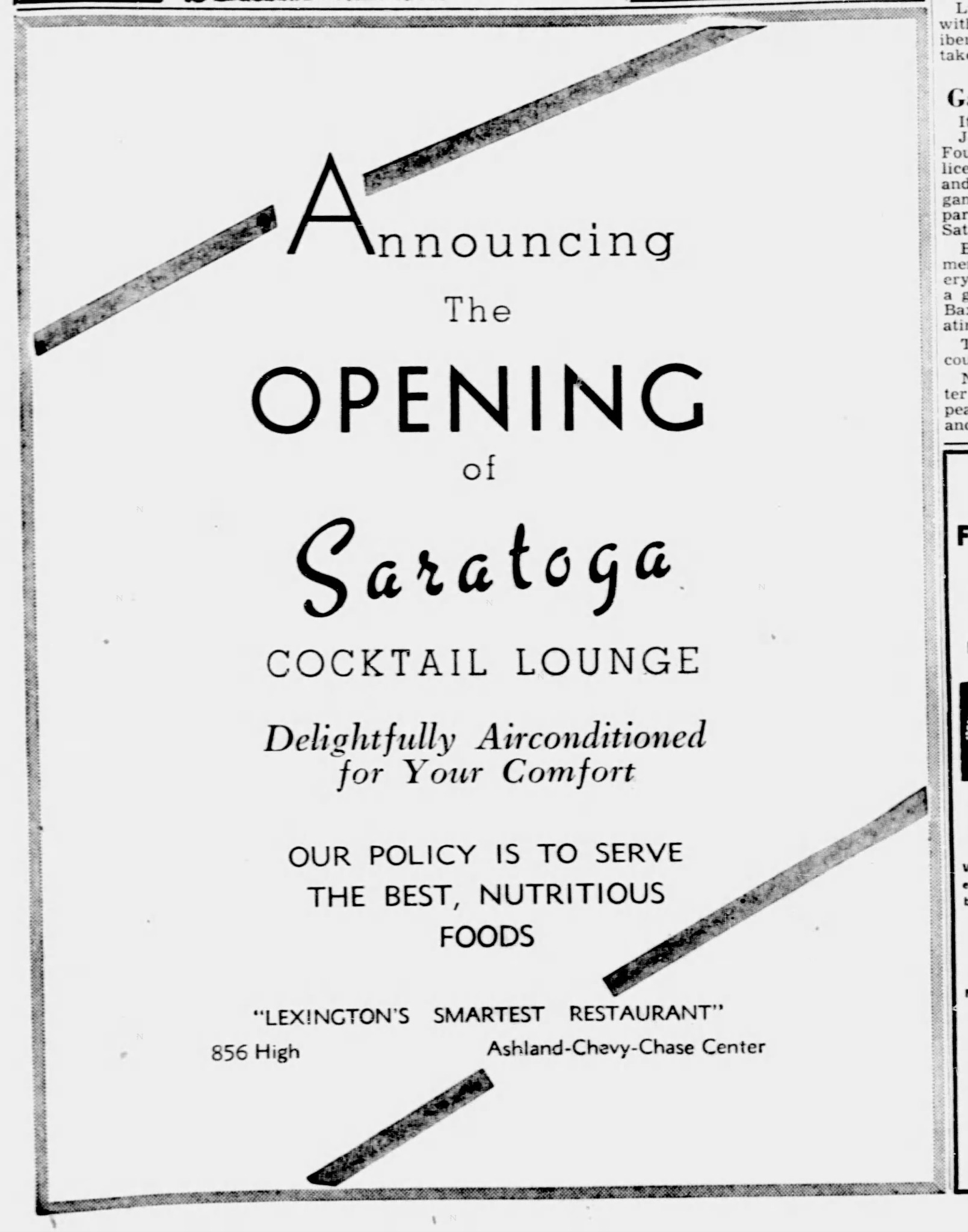 The bar opensSaratoga announces the opening of its cocktail lounge and stresses the comfort of air conditioning. The advertisement retains the restaurant’s family-food identity with a promise of nutritious meals and its established Lexington’s Smartest Restaurant slogan.
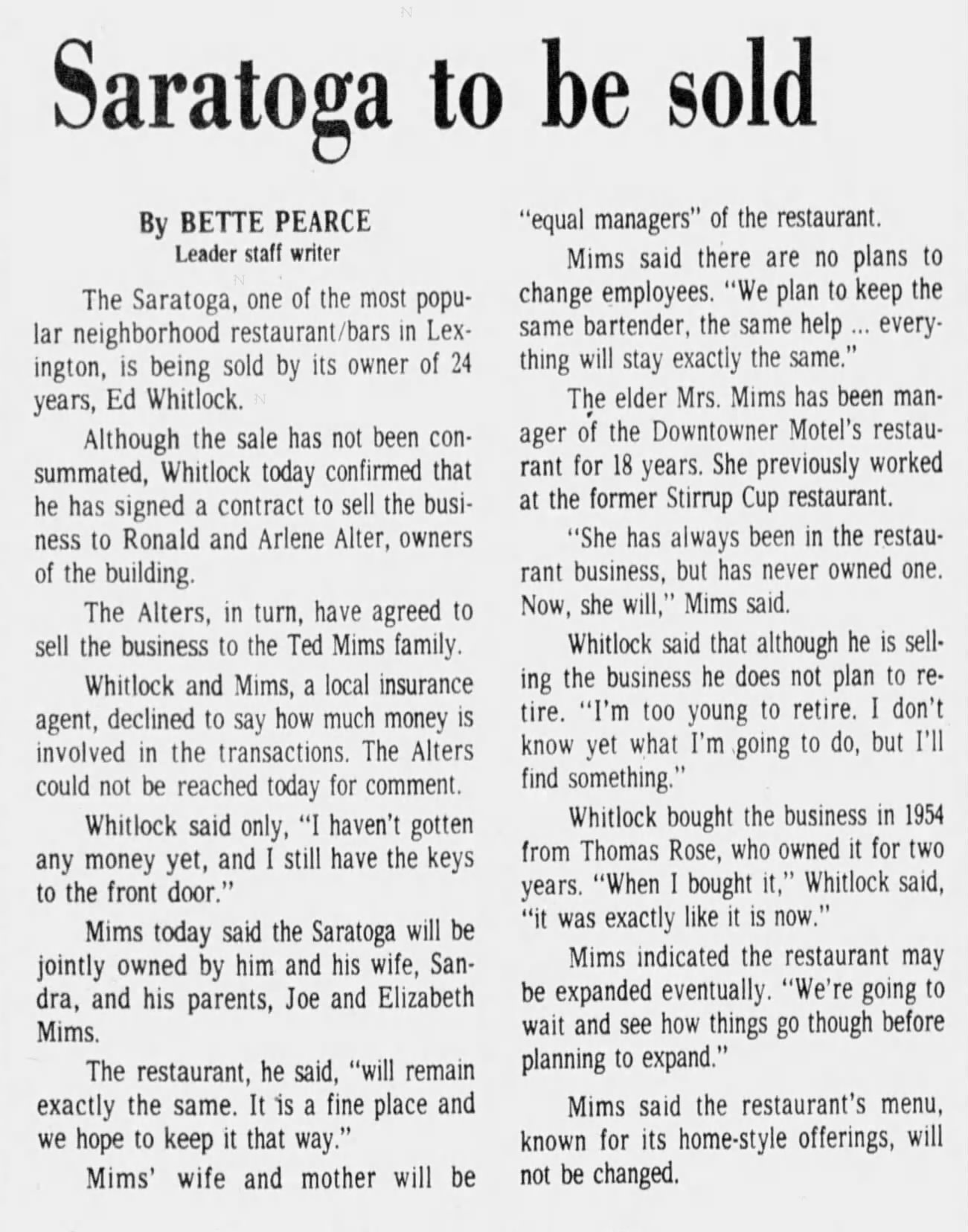 The Mims family prepares to take overA pending sale would transfer Ed Whitlock’s 24-year business through building owners Ronald and Arlene Alter to Ted, Sandra, Joe and Elizabeth Mims. The incoming family promised to retain the staff and home-style menu, with Sandra and Elizabeth sharing management.
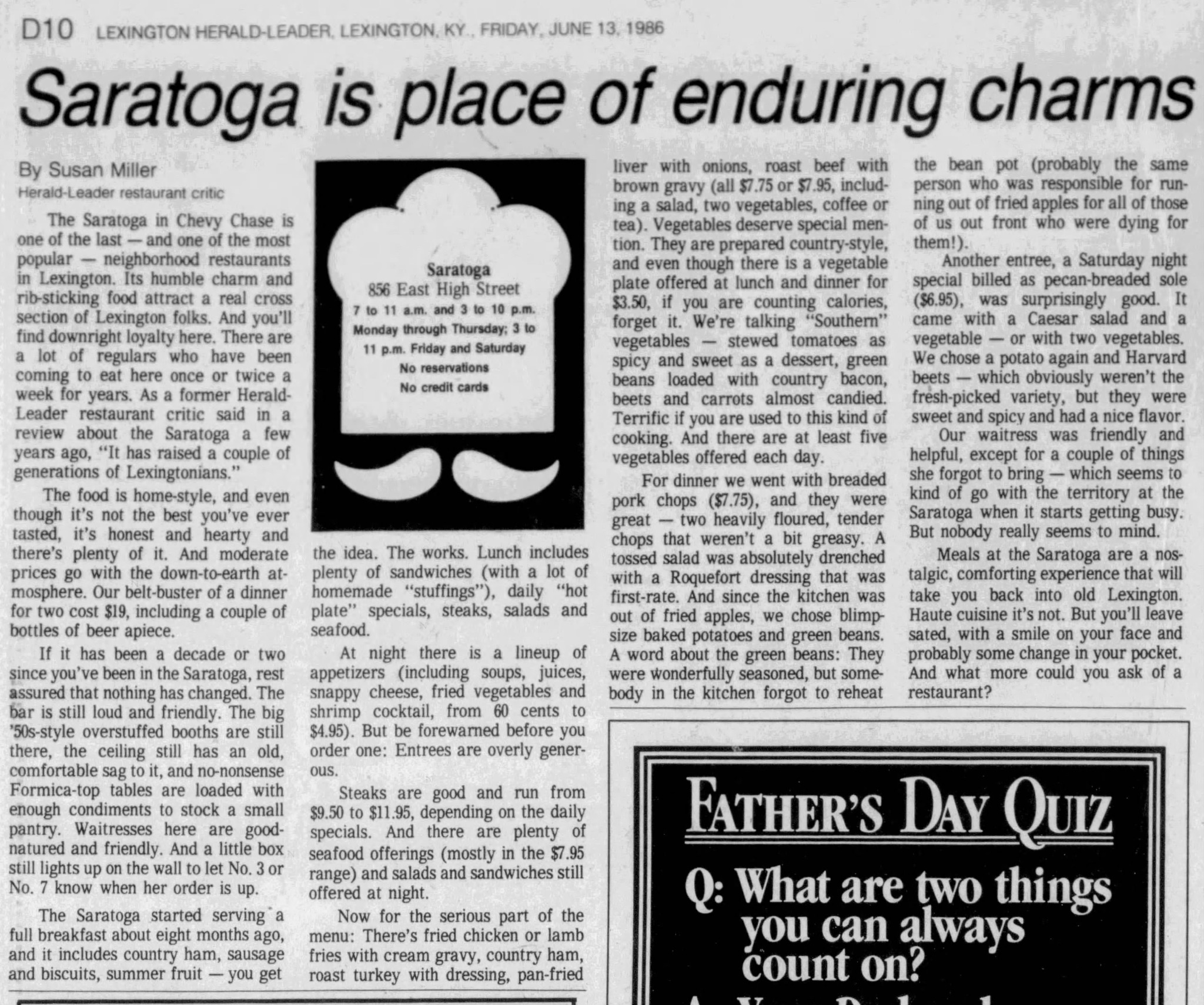 A place of enduring charmsSusan Miller’s review praises Saratoga’s generous home-style food, modest prices and familiar room, while noting small service lapses and cold green beans. Dinner for two with a couple of beers apiece cost $19; daily plate lunches, sandwiches, country-style entrées and rich vegetables still defined the menu.
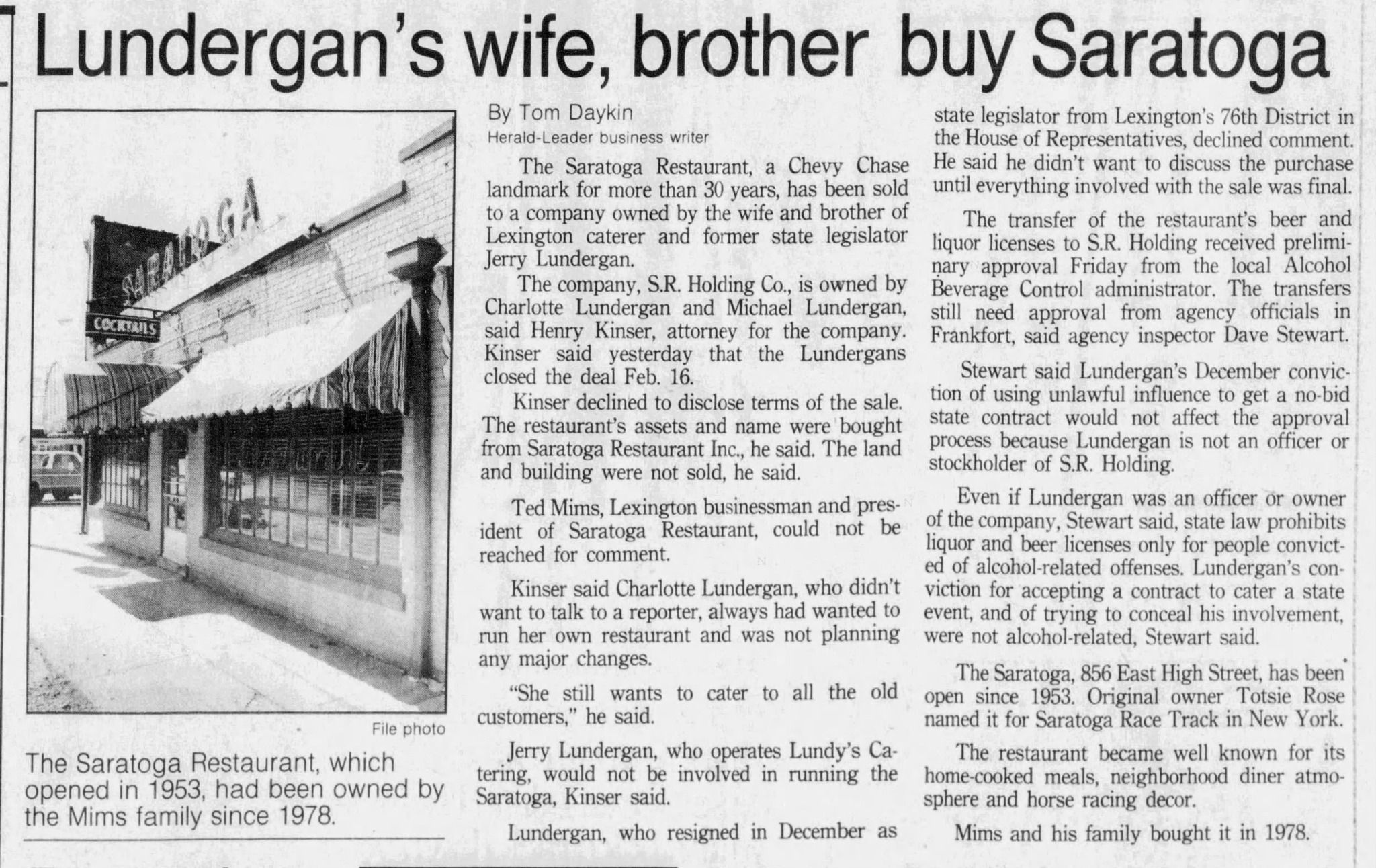 The Lundergan purchaseTom Daykin reports that S.R. Holding Co., owned by Charlotte and Michael Lundergan, closed its purchase of Saratoga’s name and assets on February 16. The land and building were excluded; attorney Henry Kinser said Charlotte planned no major changes and wanted to retain the old clientele.
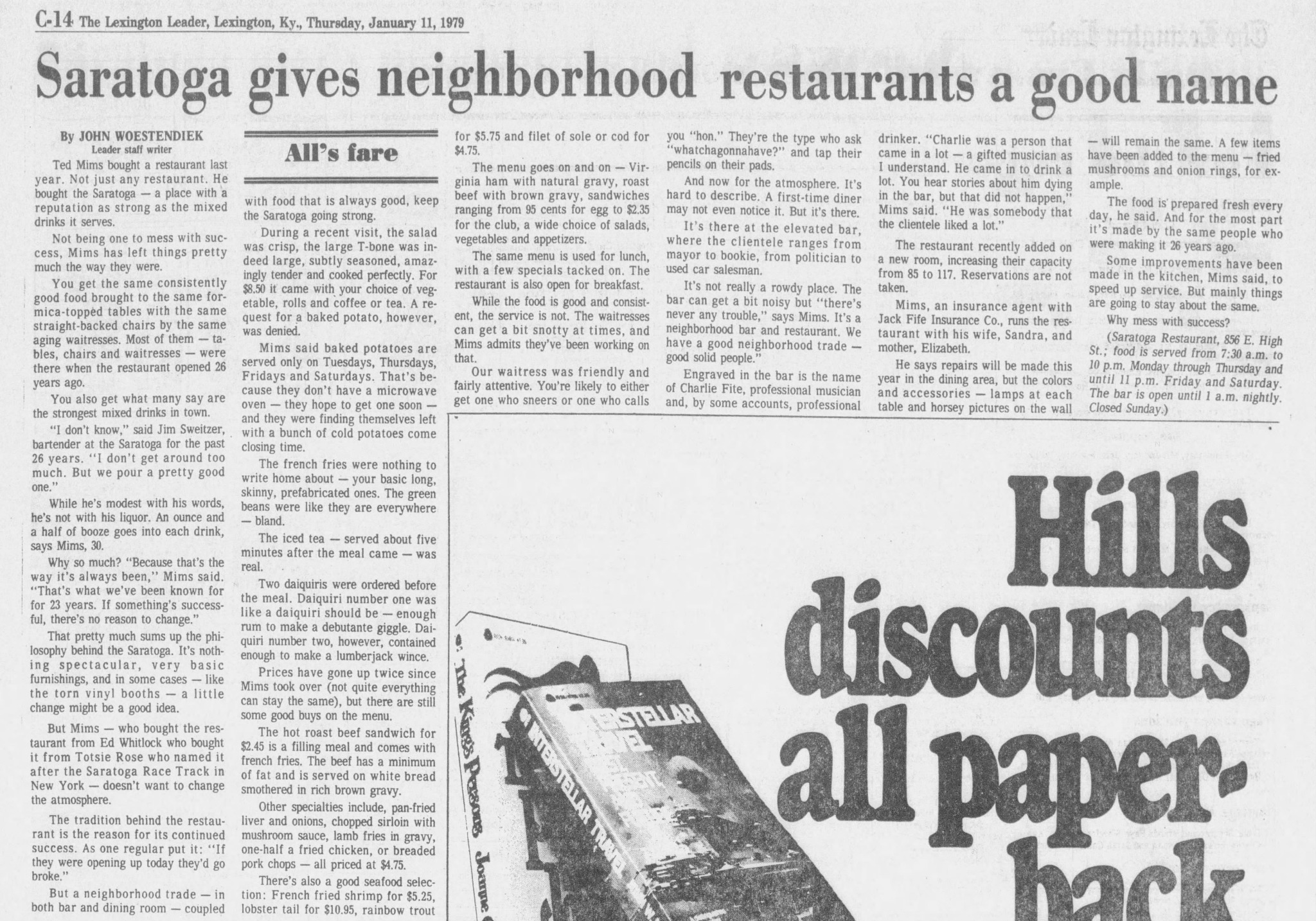 A neighborhood restaurant, one year into the Mims eraJohn Woestendiek’s 1979 review finds familiar food, strong drinks and a loyal neighborhood trade under Ted Mims. It records the expanded 117-seat dining room, veteran bartender Jim Sweitzer, daily operations and a detailed menu—from a $2.45 hot roast-beef sandwich to an $8.50 T-bone.
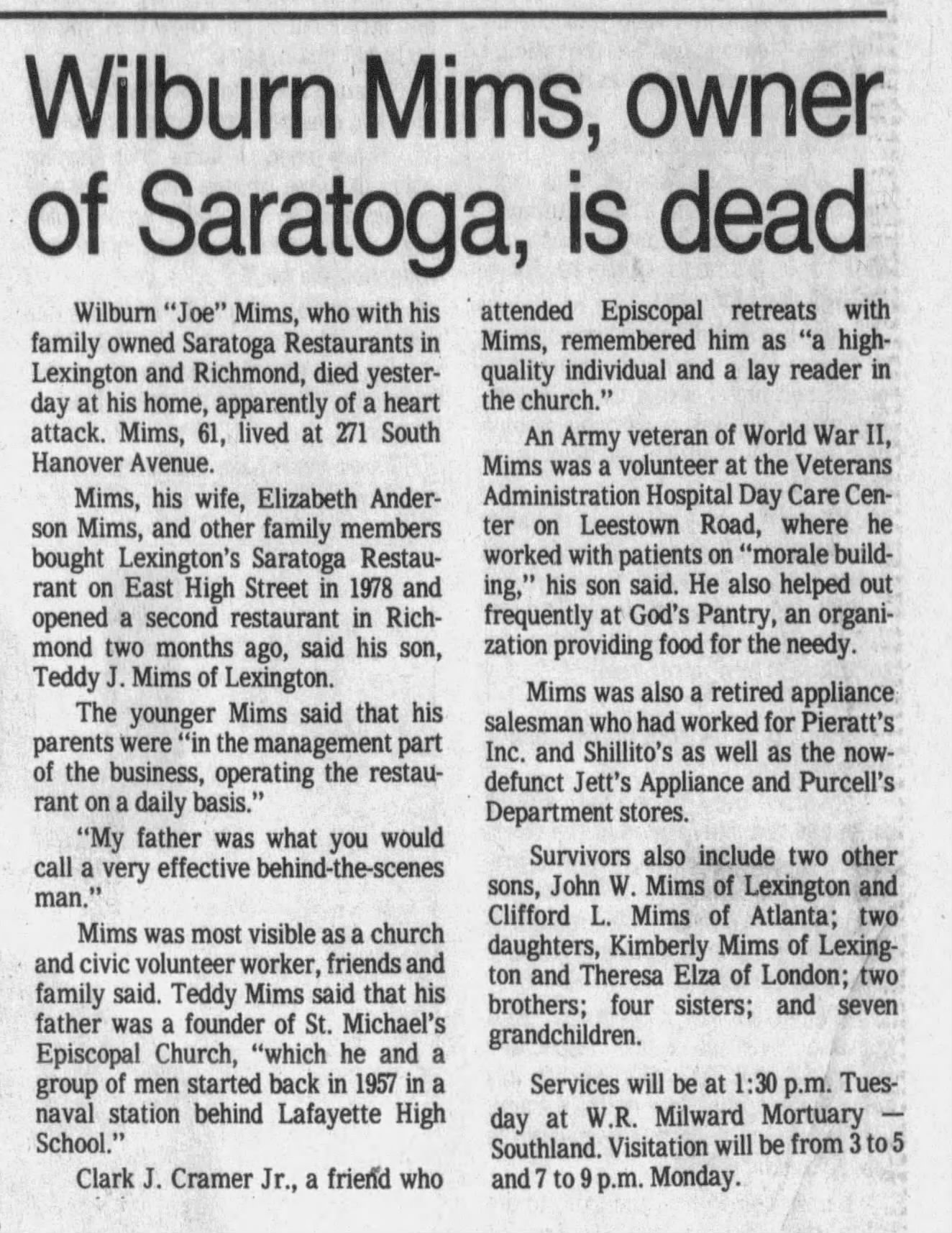 Remembering Wilburn “Joe” MimsThe obituary remembers Wilburn “Joe” Mims, 61, as a family owner and daily operator of Saratoga Restaurant restaurants, an effective behind-the-scenes presence and a church and civic volunteer. It also records the family’s Richmond restaurant, opened two months earlier.
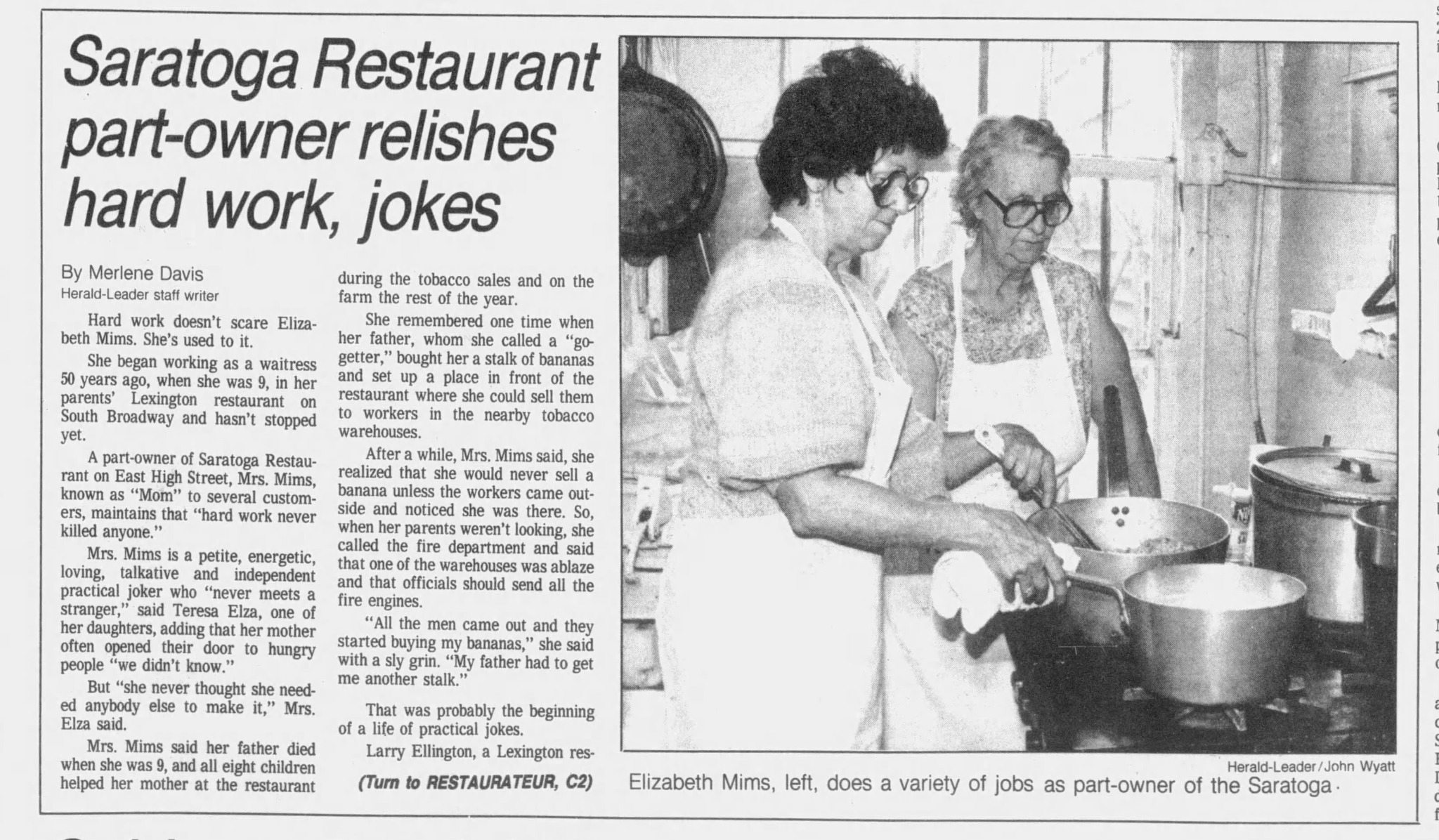 Liz Mims: hard work and practical jokes · Part 1Merlene Davis introduces Elizabeth Mims, a Saratoga part-owner known as “Mom,” with a kitchen photograph by John Wyatt. Her daughter recalls generosity, independence and a lifetime of work; Liz supplies a childhood practical joke.
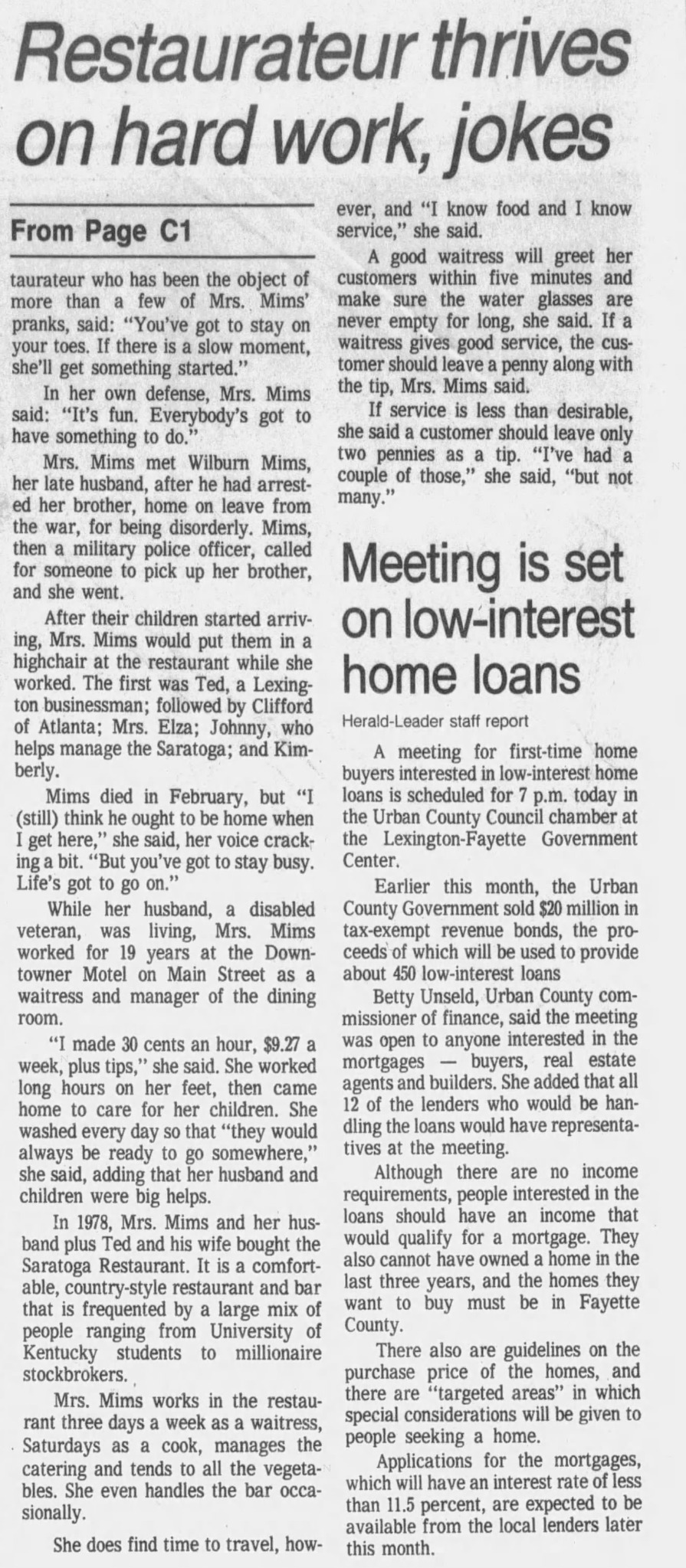 Liz Mims: hard work and practical jokes · Part 2The continuation names the family behind the 1978 purchase and describes Liz’s work: waiting tables, cooking Saturdays, catering, vegetables and the occasional bar shift. It also covers Johnny’s management role, Wilburn’s death and her standards for service.
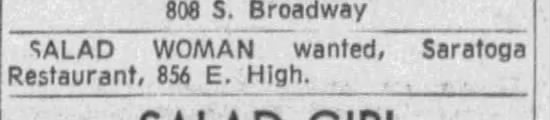 The kitchen needed a salad womanA 1973 classified ad seeks a 'salad woman' for Saratoga Restaurant at 856 E. High, a small record of the kitchen work behind the dining room.
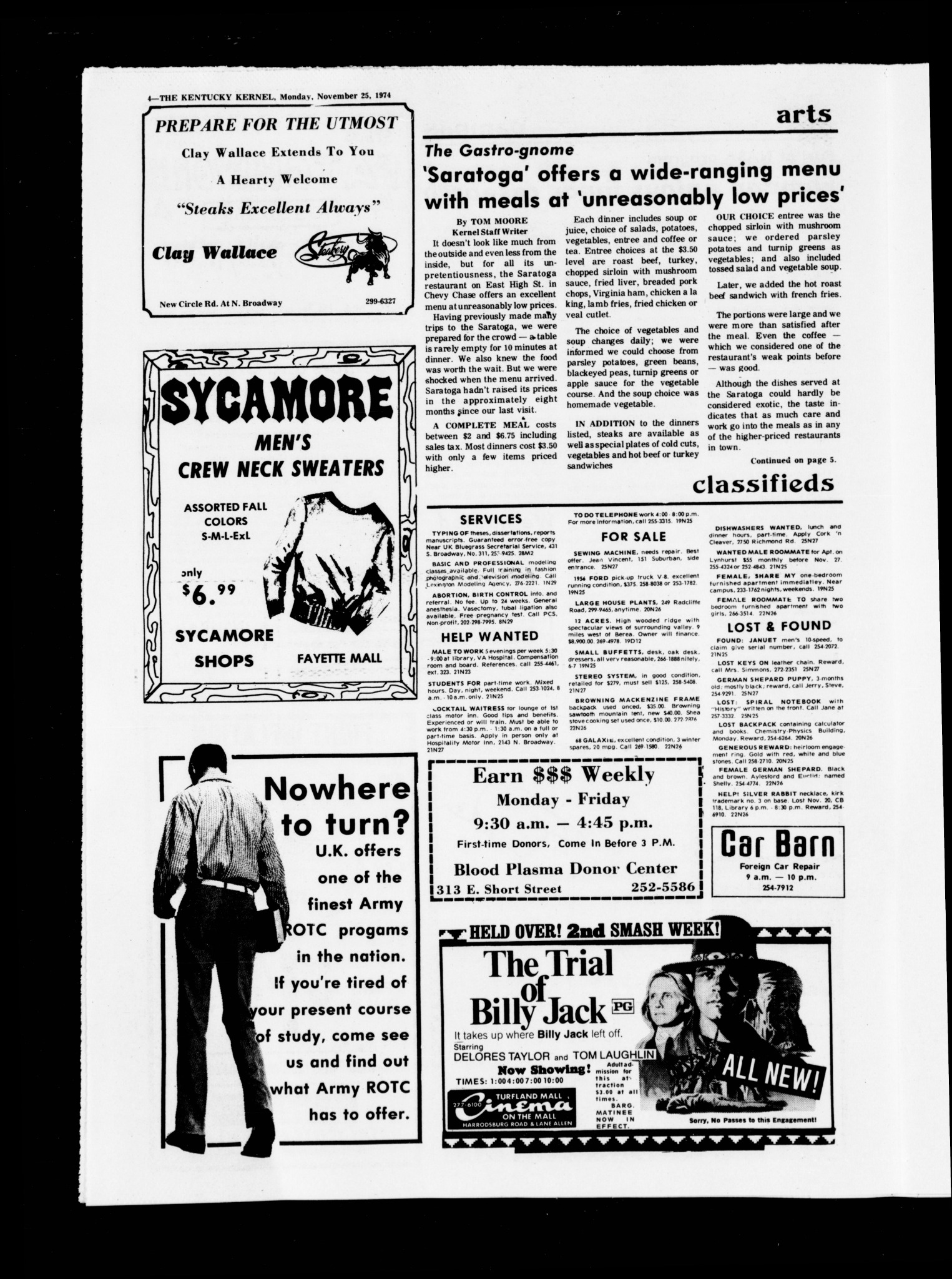
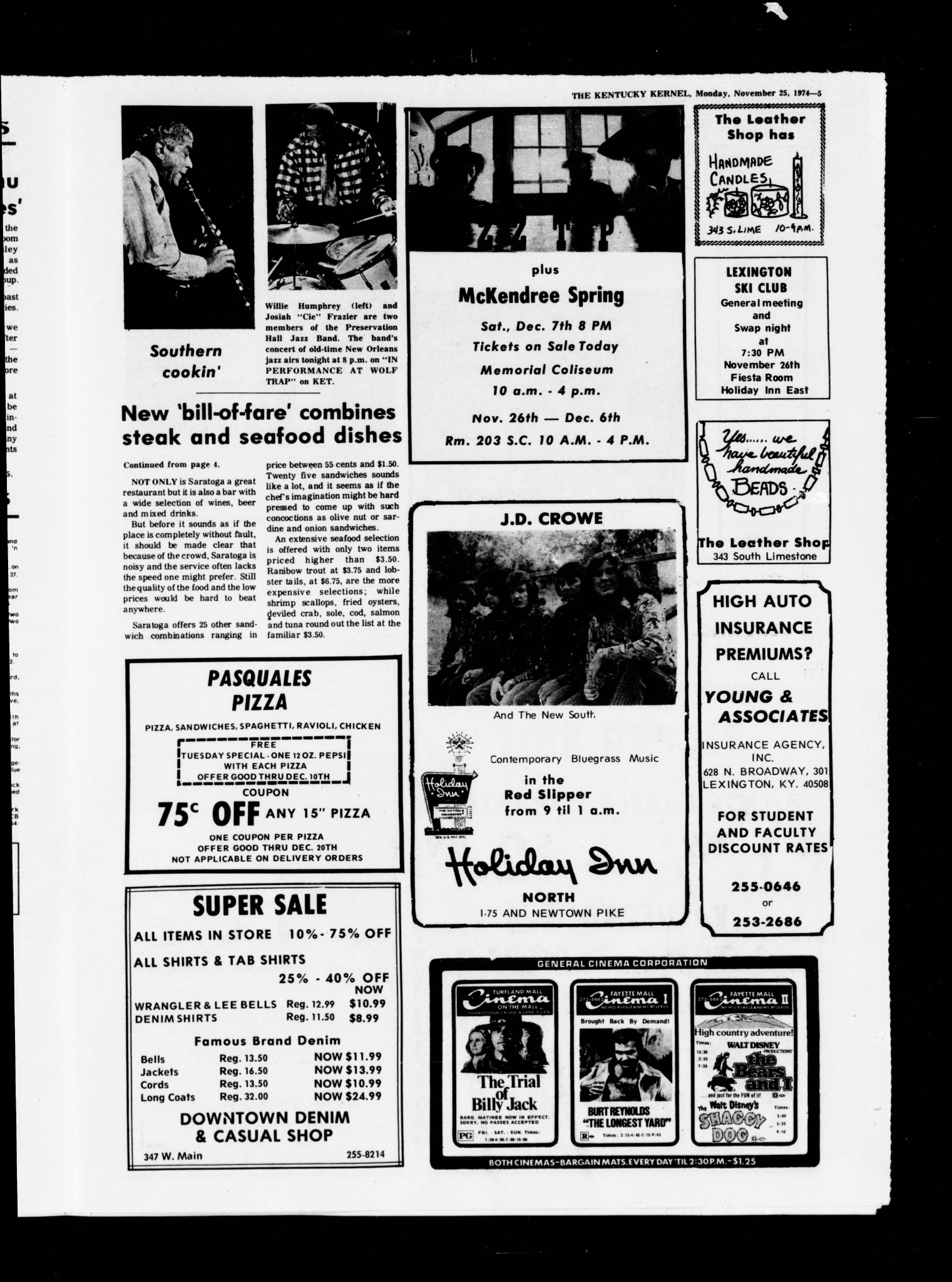
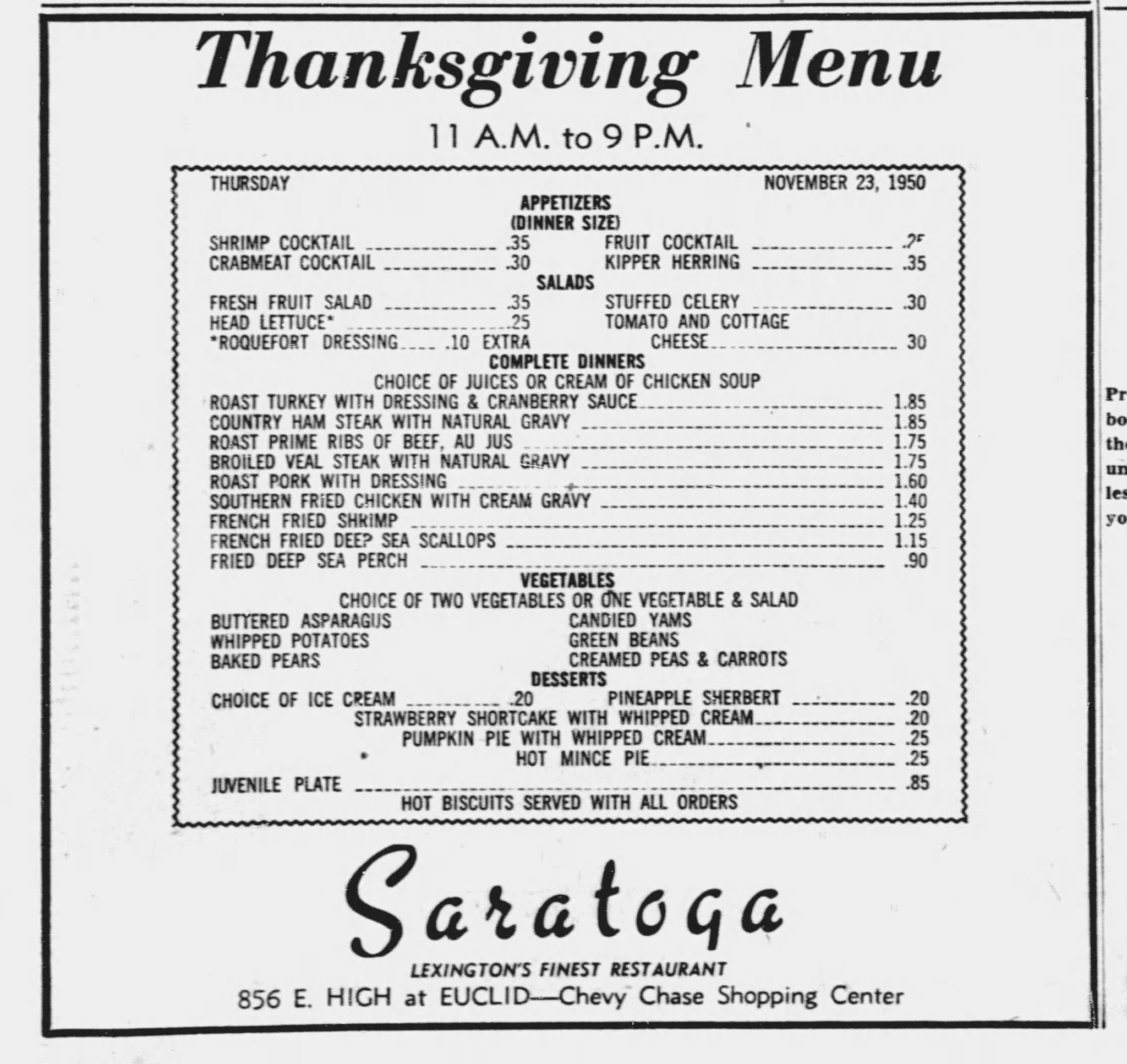 Thanksgiving at Saratoga RestaurantThe advertisement publishes a Thanksgiving menu for Thursday, November 23, 1950, served 11 a.m.–9 p.m. Complete dinners ranged from 90-cent perch to $1.85 turkey or country ham and included juice or cream of chicken soup plus a choice of two vegetables or one vegetable and salad; hot biscuits accompanied every order.
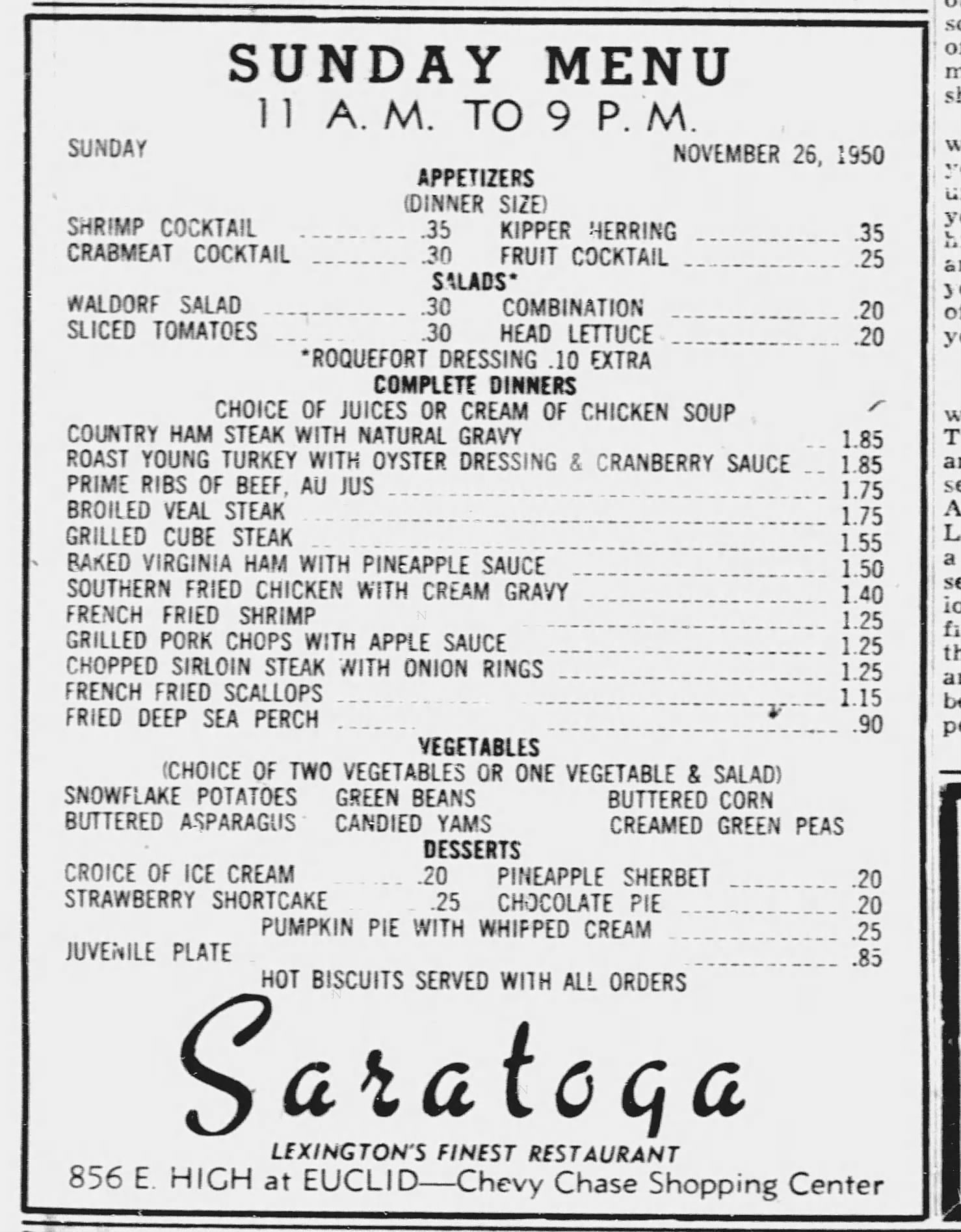 A Sunday spreadThe dated November 26, 1950 menu offers Sunday dining from 11 a.m. to 9 p.m., with twelve complete dinner choices. Country ham and turkey with oyster dressing cost $1.85, prime rib and veal $1.75, and perch 90 cents; meals included juice or soup, vegetables and biscuits, with desserts priced separately.
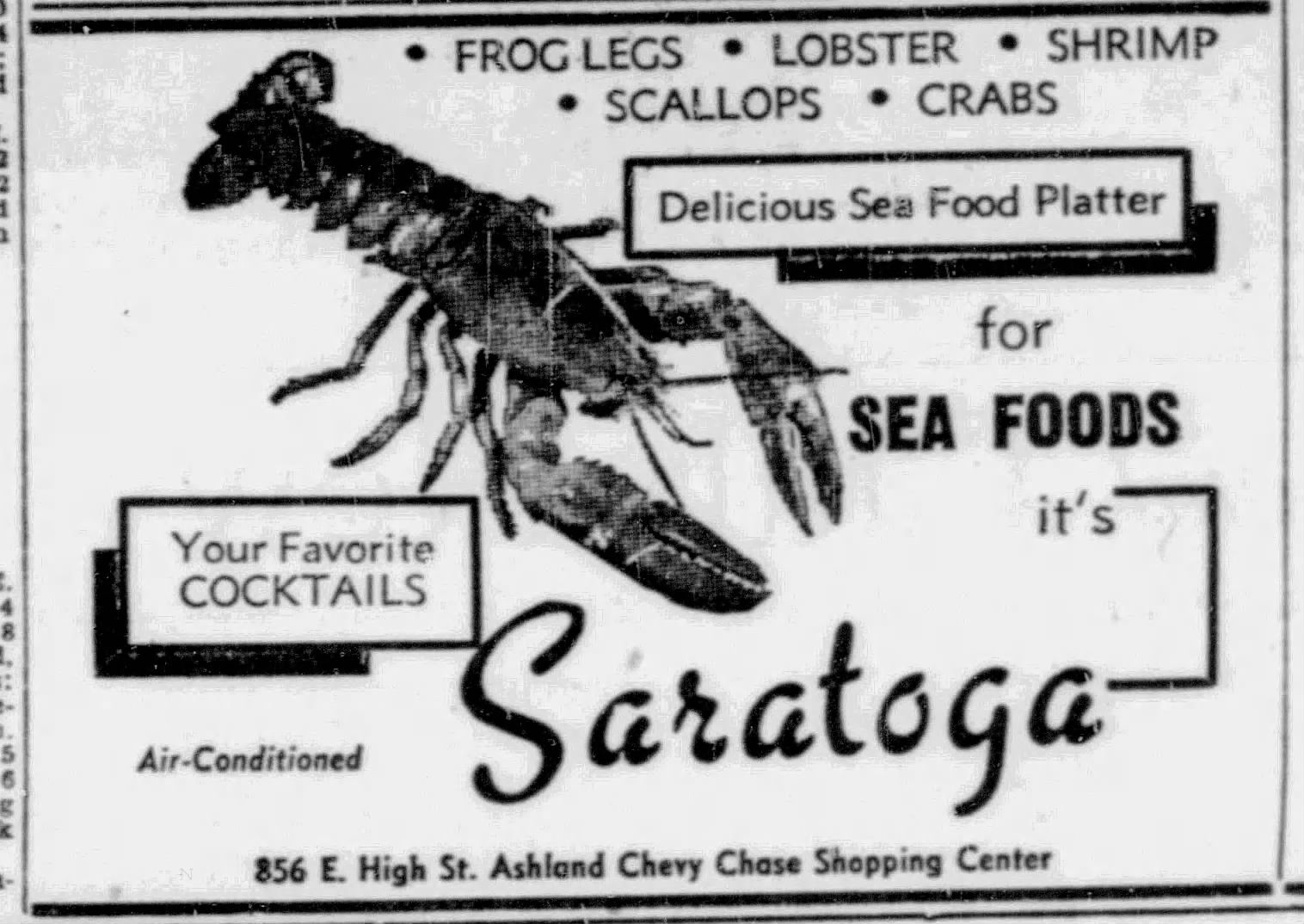 Seafood and cocktailsAn illustrated seafood advertisement promotes frog legs, lobster, shrimp, scallops, crabs and a seafood platter. Cocktails and air conditioning are also selling points at the 856 East High Street restaurant.
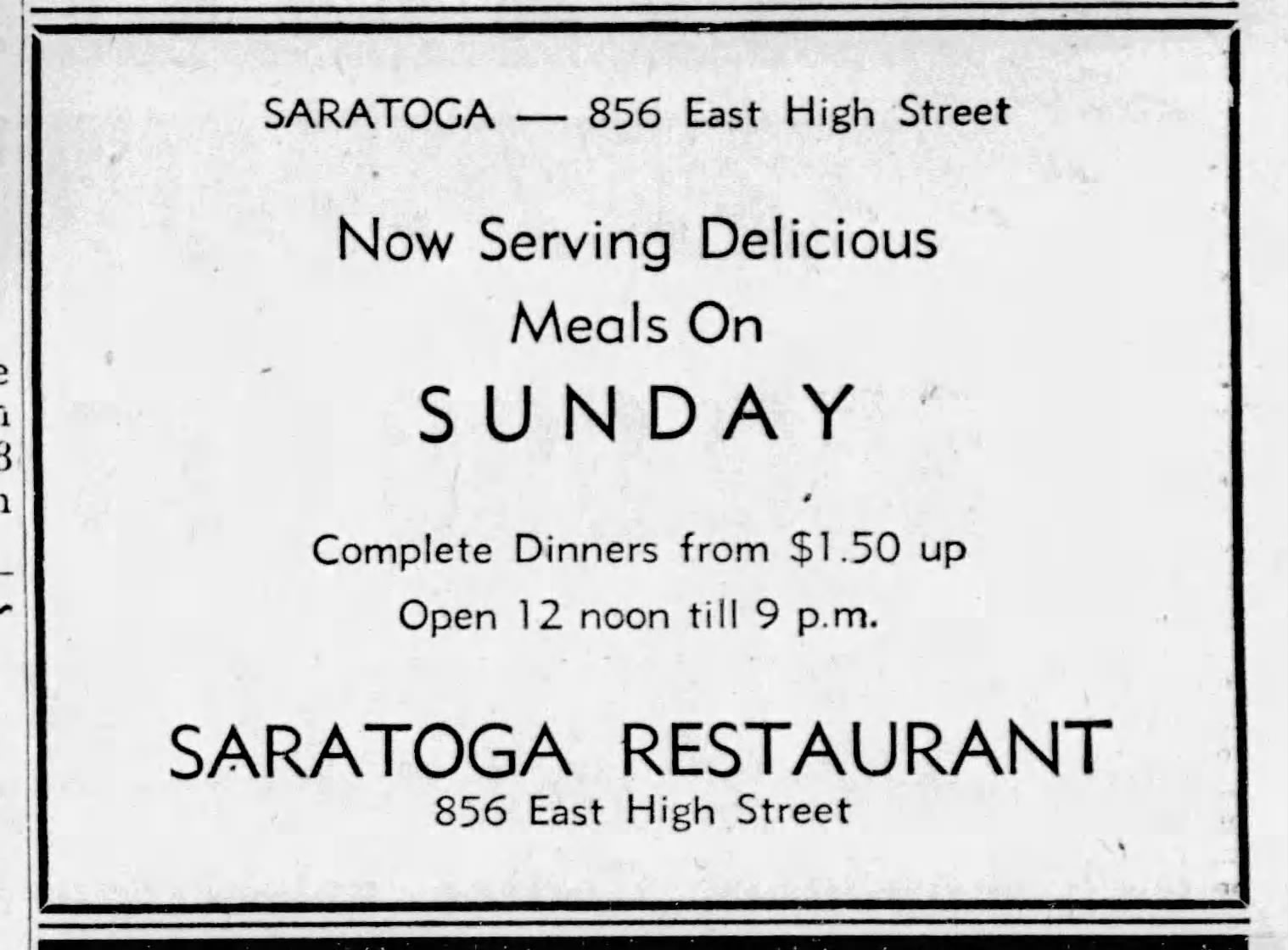 Sunday dinner, from a dollar fiftyComplete dinners from $1.50; the doors open at noon.
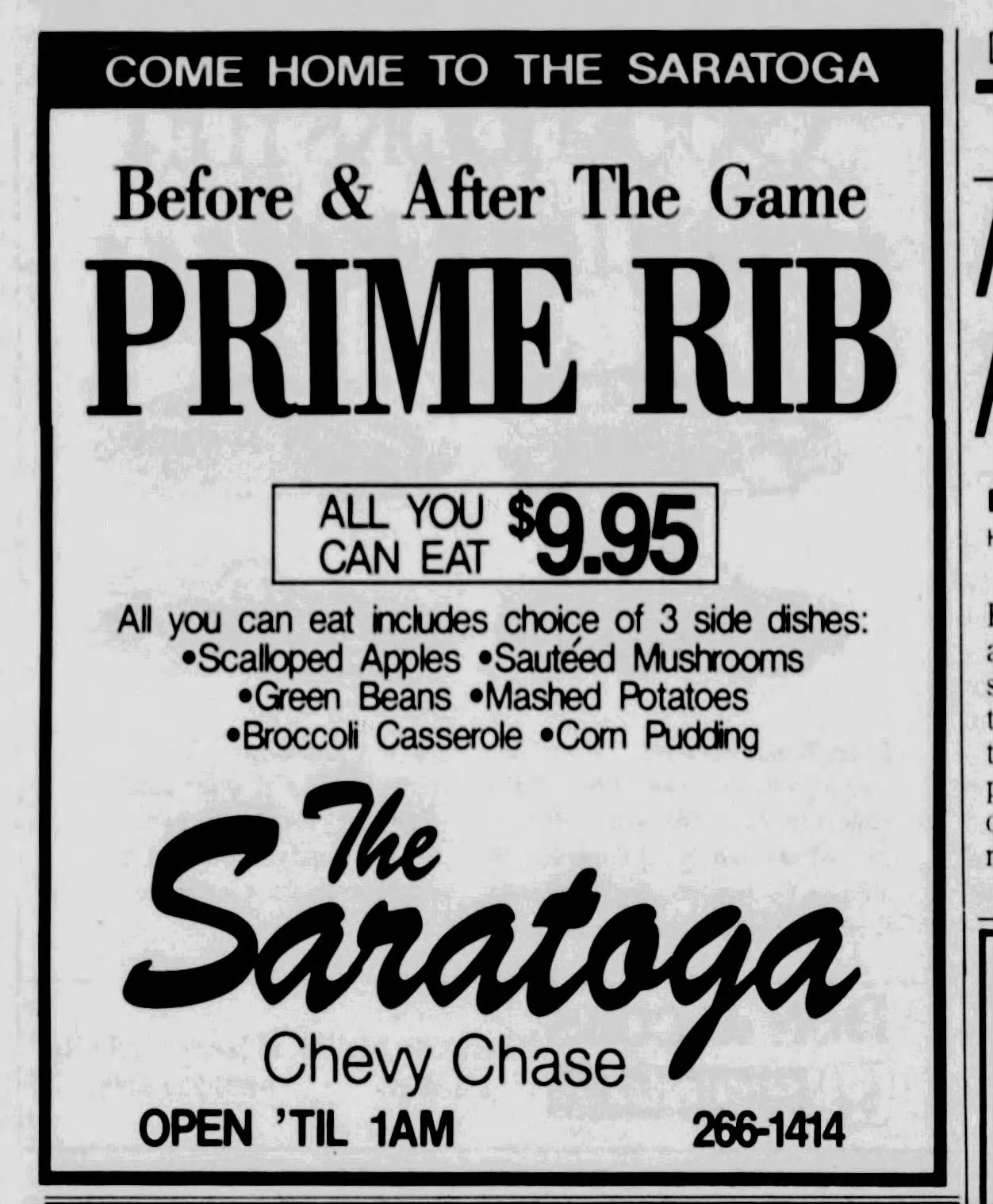 Come home before or after the gameAll-you-can-eat prime rib with a choice of three sides, open until 1 a.m.
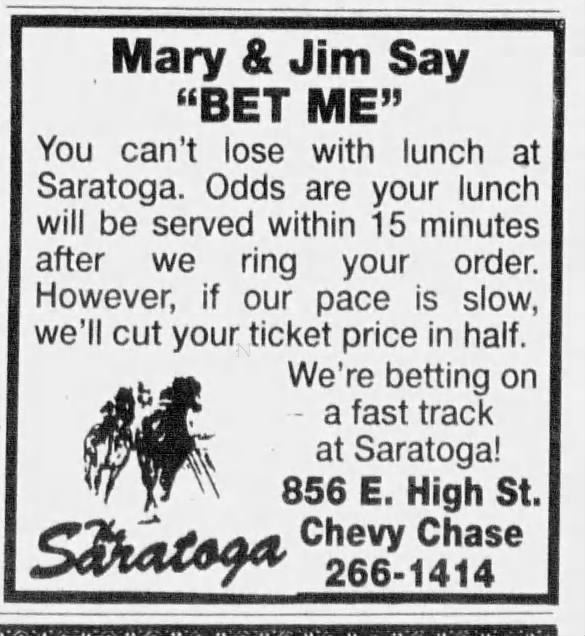 Lunch in fifteen minutes—or half priceAn advertisement signed “Mary & Jim” promises lunch within fifteen minutes after the order is rung. If service runs slower, the restaurant promises to cut the bill in half, carrying its racing theme into a practical lunch offer.
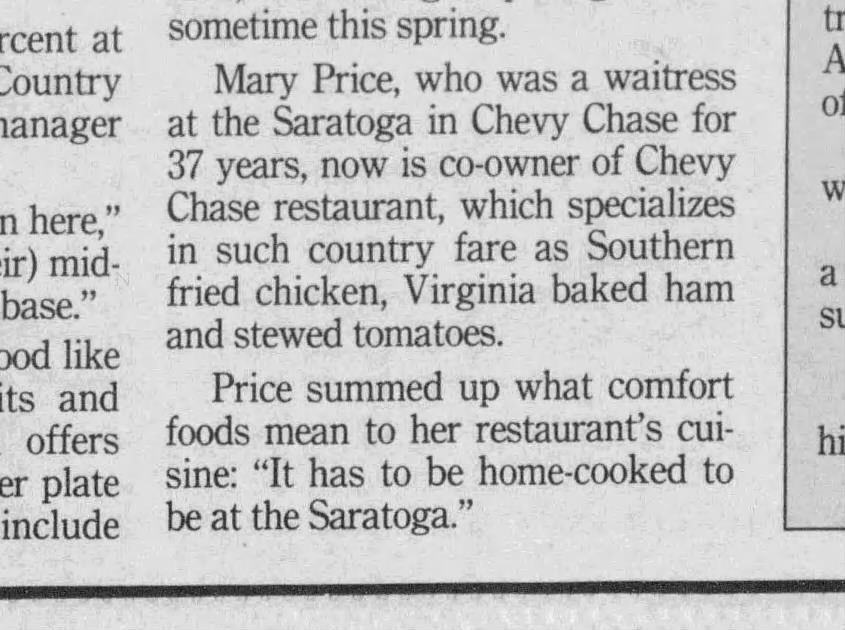 Mary Price defines comfort foodA short excerpt describes Mary Price as a Saratoga co-owner after 37 years as a waitress. It identifies Southern fried chicken, Virginia baked ham and stewed tomatoes as specialties and quotes Price’s insistence that Saratoga food be home-cooked.
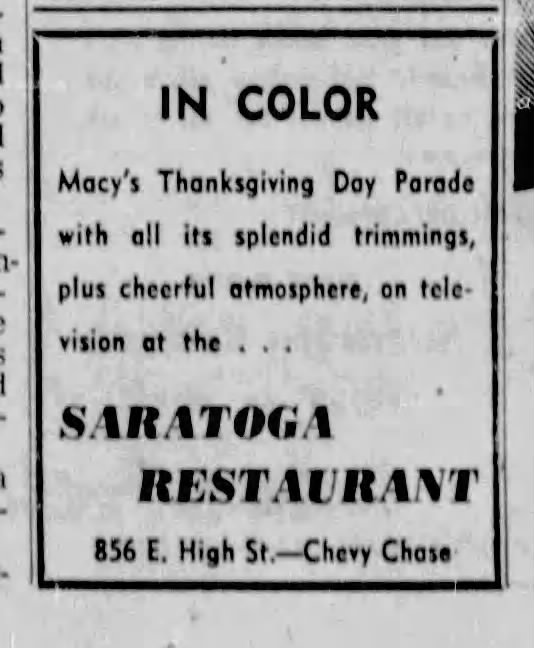 Thanksgiving, in living colorThe Macy’s parade was part of the attraction.
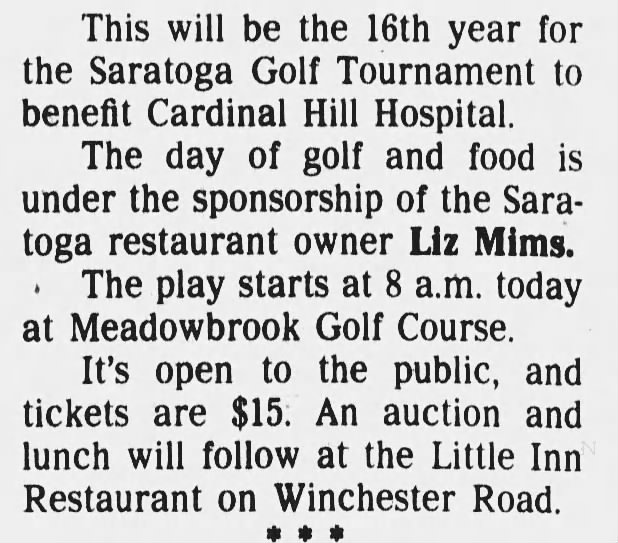 Liz takes Saratoga Restaurant spirit to the golf courseA brief announces the 16th year of the Saratoga Golf Tournament for Cardinal Hill Hospital, sponsored by restaurant owner Liz Mims. Public play began at Meadowbrook Golf Course, with $15 tickets and an auction and lunch afterward at the Little Inn Restaurant.
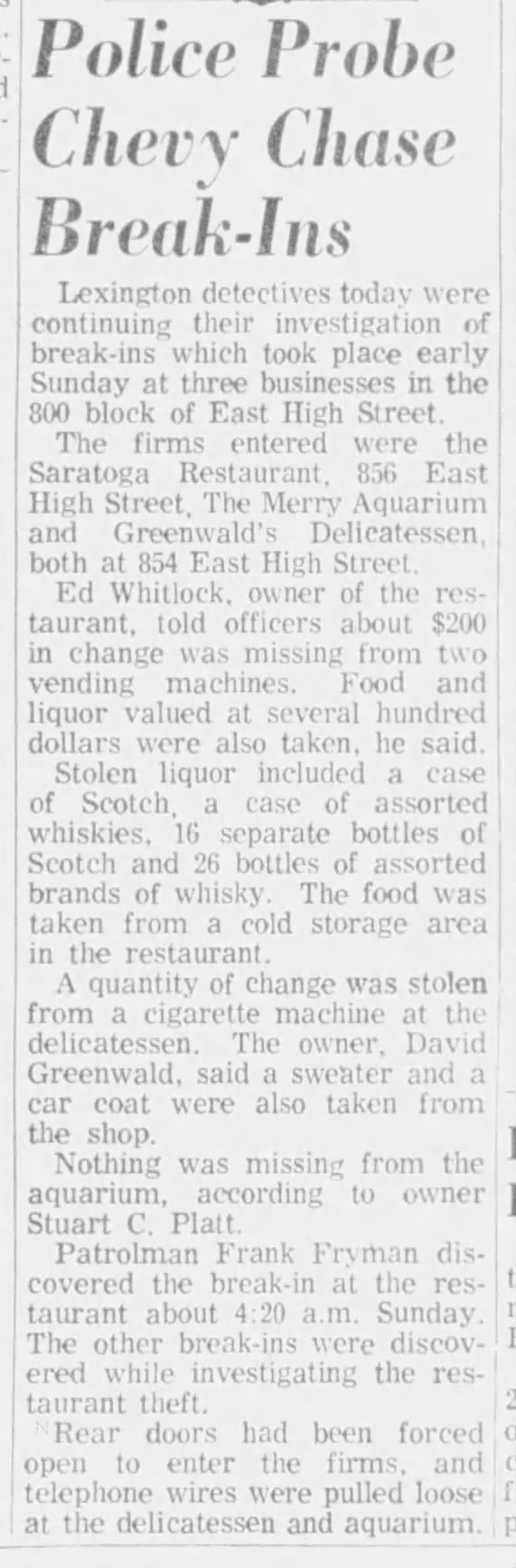 Three break-ins on East High StreetA 1962 report describes break-ins at Saratoga and two neighboring East High Street businesses. Owner Ed Whitlock told police that roughly $200 in vending-machine change, food, and substantial liquor stocks were missing; the restaurant break-in was discovered about 4:20 a.m. Sunday.
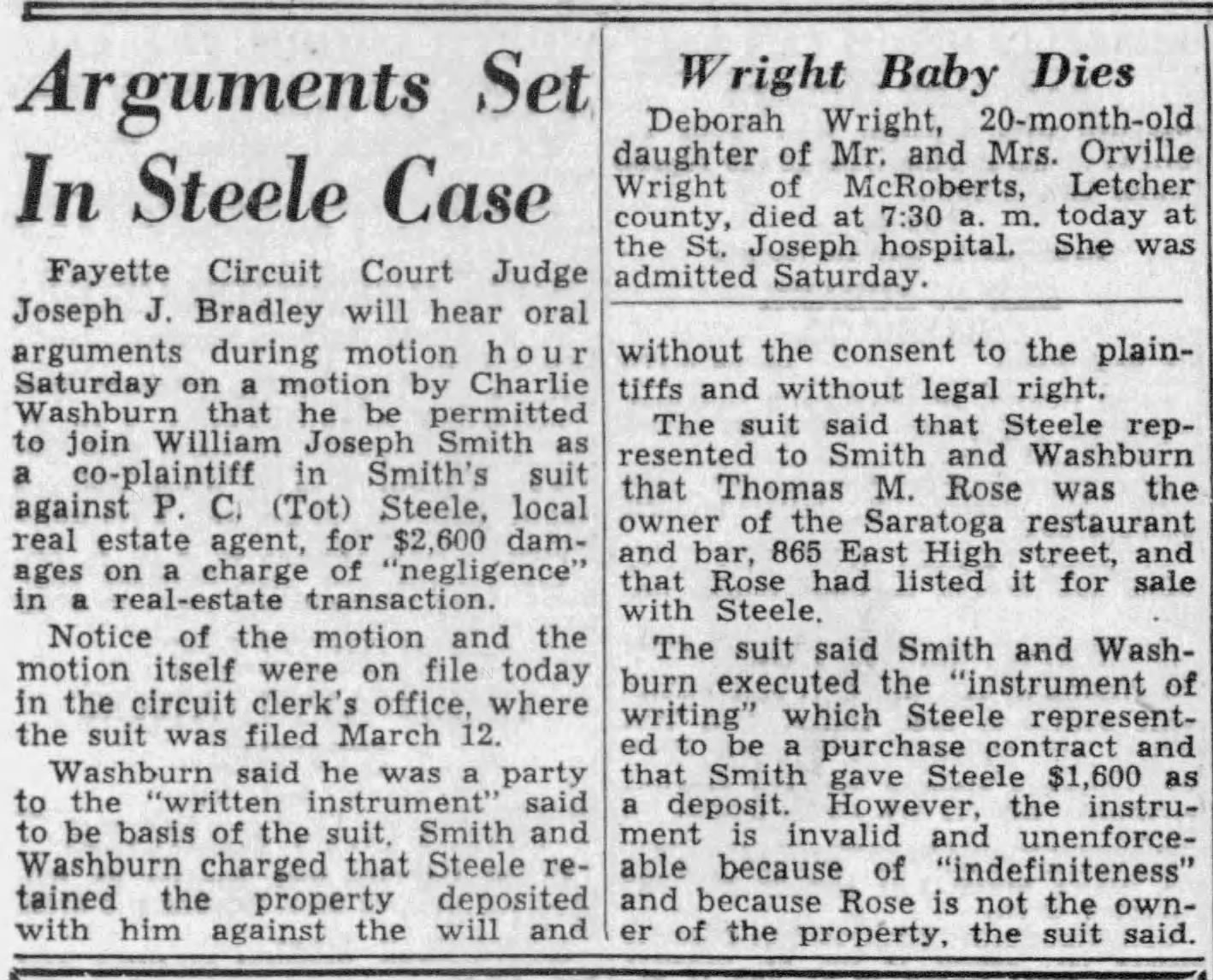 A proposed sale reaches courtCharlie Washburn sought permission to join William Joseph Smith’s $2,600 suit against real-estate agent P. C. “Tot” Steele over a proposed Saratoga purchase. The buyers alleged that their agreement was indefinite, that Rose did not own the property, and that Steele improperly retained a $1,600 deposit; these are allegations reported before disposition.
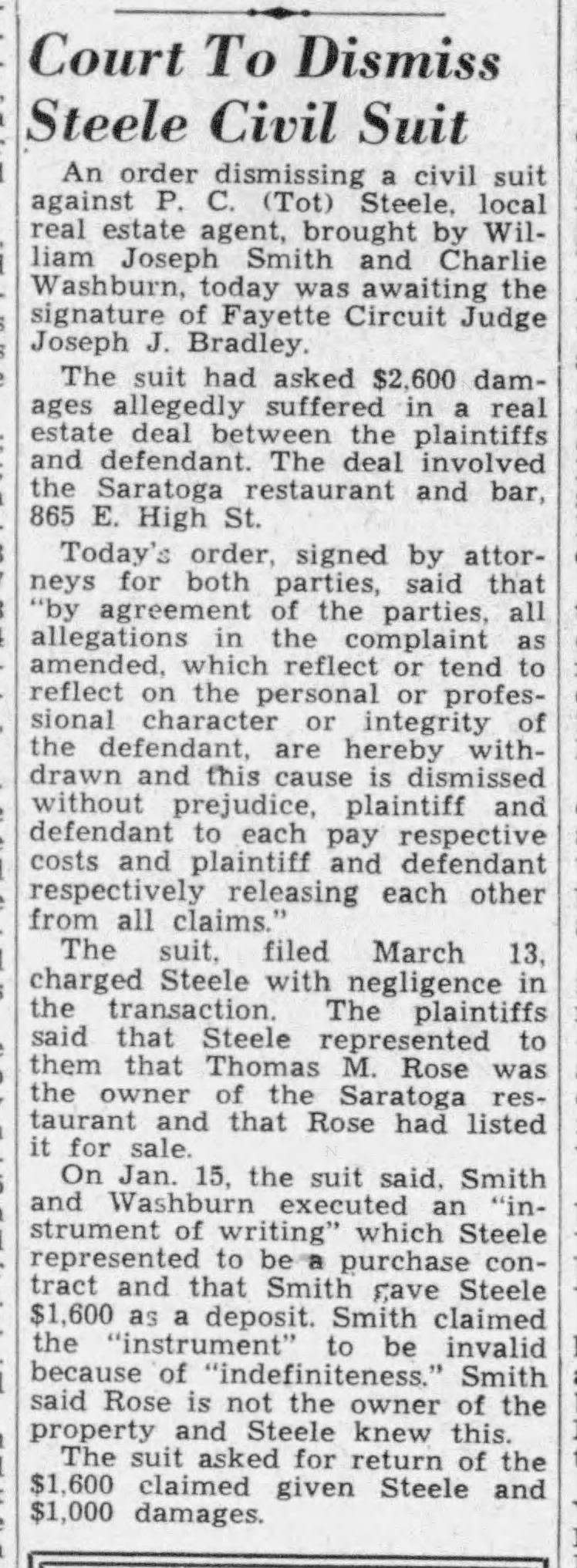 An agreement to end the disputeAn agreed order dismissing the Smith–Washburn suit against Steele awaited Judge Joseph J. Bradley’s signature. The terms withdrew character-related allegations, dismissed without prejudice, assigned each party its own costs, and released mutual claims; the article explains that the $2,600 demand comprised the $1,600 deposit and $1,000 damages.
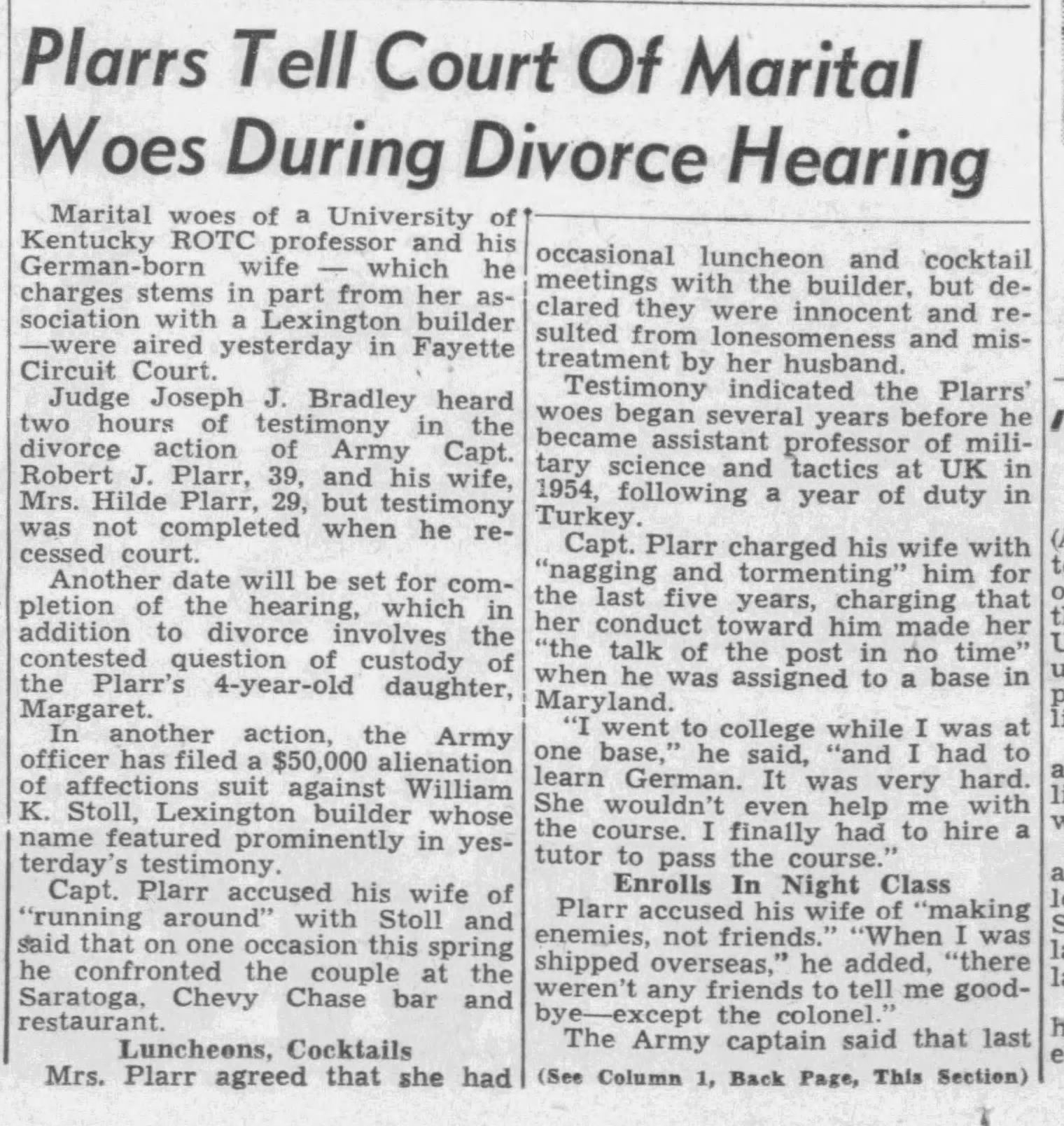 A divorce case passes through the barIn a Fayette Circuit Court divorce hearing, Army Capt. Robert J. Plarr testified that he had confronted his wife Hilde and builder William K. Stoll at Saratoga that spring. Hilde acknowledged lunches and cocktails with Stoll while maintaining that the meetings were innocent; the hearing was unfinished and the clipping continues elsewhere.
 A meeting at Saratoga enters court testimonyThis continuation reports competing accounts in the Plarr–Stoll litigation. Capt. Plarr testified that he followed a car to Saratoga and found his wife inside while Stoll stood at the jukebox. The defense disputed his account of the marriage and responsibility for its breakdown. These are reported allegations and testimony, not an established account of wrongdoing.
 The following day’s court reportThe report continues testimony by Stoll, who said he married the former Mrs. Plarr on January 15, 1957. It recounts his version of Saratoga Restaurant encounter, evidentiary rulings and other witnesses’ testimony. Despite the headline “Jury,” this supplied continuation says testimony had ended and the jury was expected to receive the case; it does not provide the verdict.
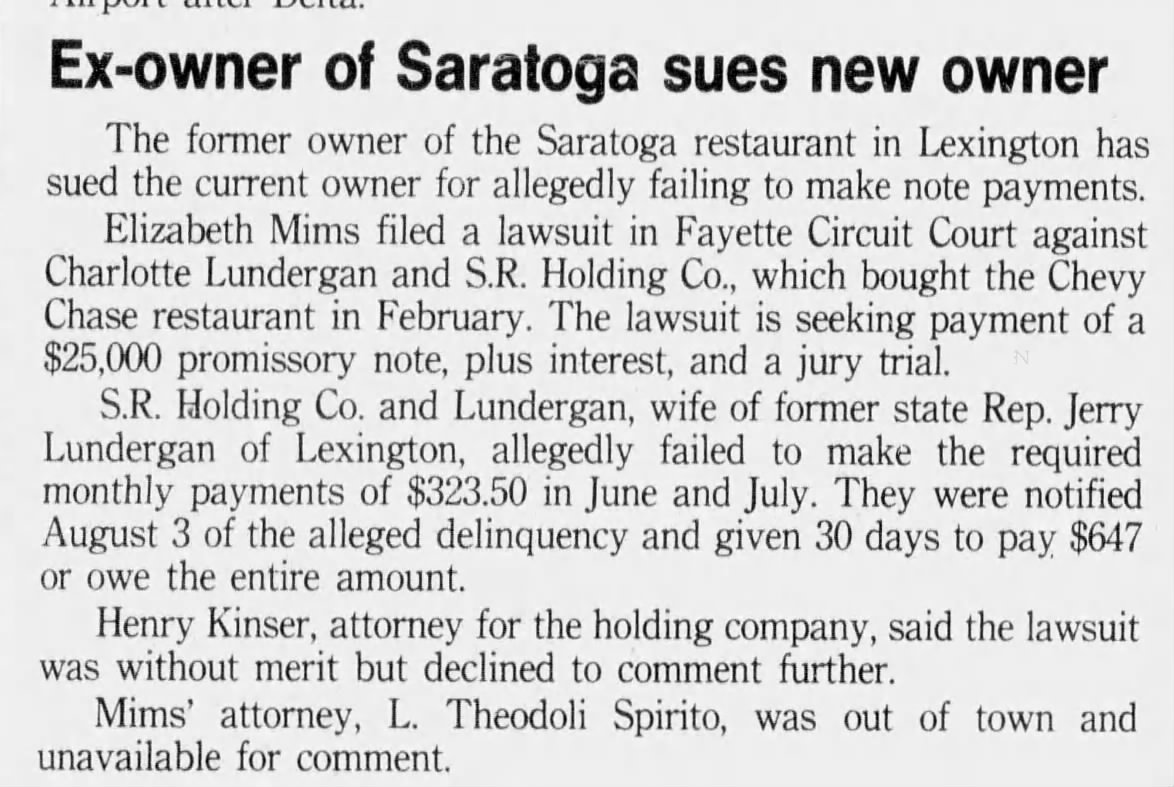 Elizabeth Mims seeks payment after the saleElizabeth Mims sued Charlotte Lundergan and S.R. Holding Co. over allegedly missed payments on a $25,000 promissory note following the February sale. The holding company's attorney called the suit without merit; the clipping reports no outcome.
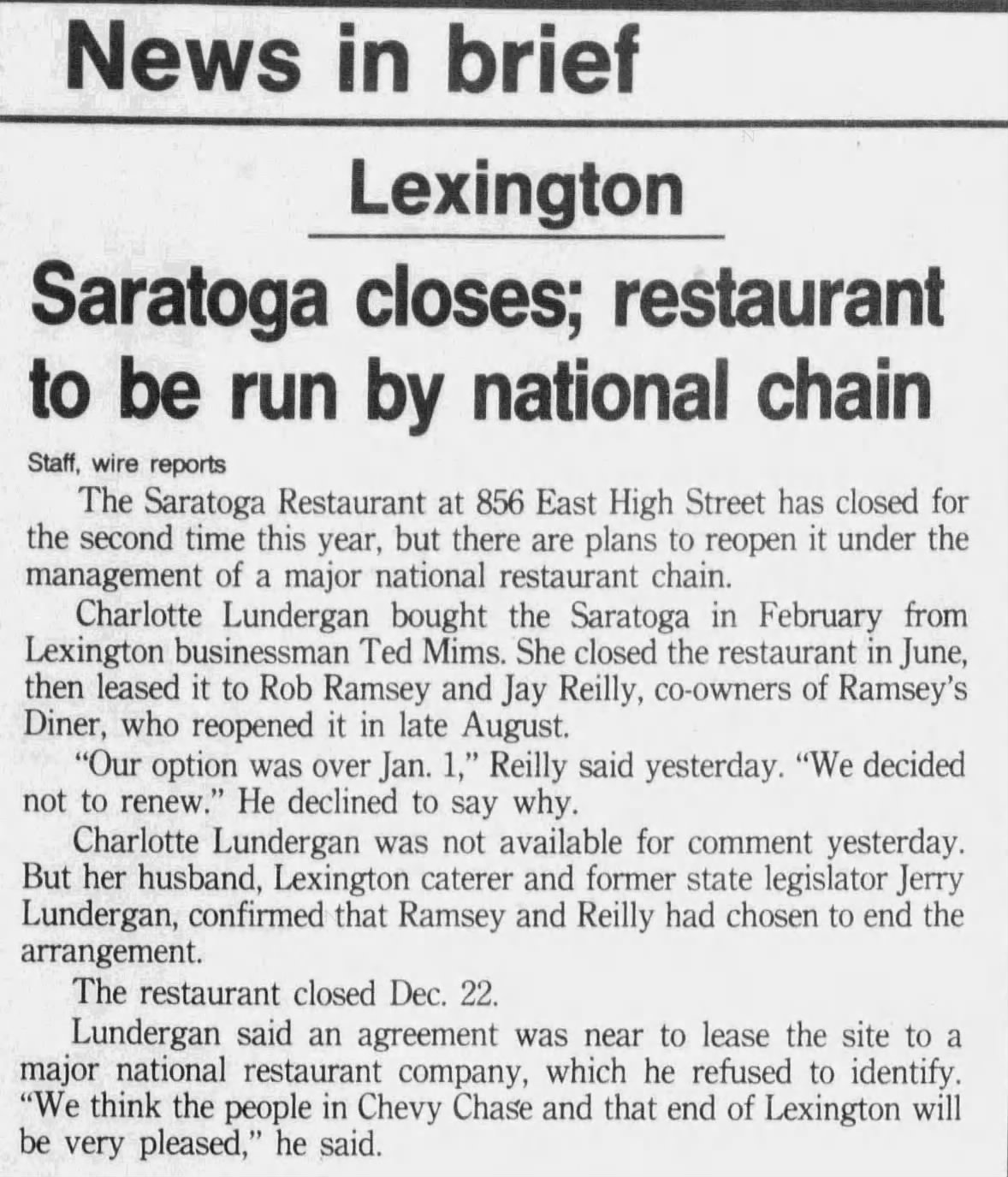 A second closing in 1990Saratoga closed December 22 after a late-August reopening by Ramsey's Diner co-owners Rob Ramsey and Jay Reilly. They declined to renew their option. Jerry Lundergan said a lease to an unnamed national restaurant company was near; the report does not confirm a completed deal.
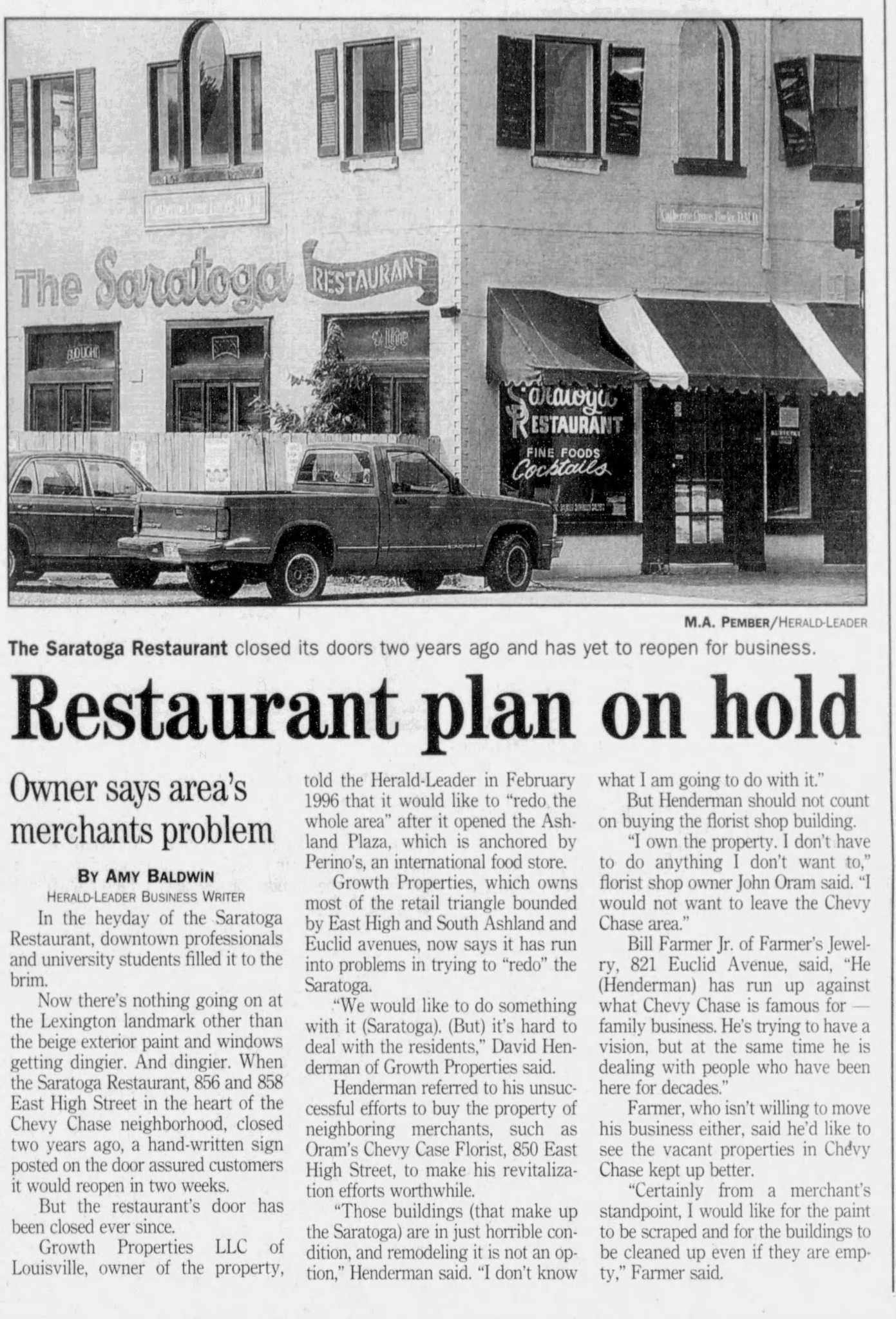 Two years closed, still waitingAmy Baldwin reports that Saratoga had remained shut for two years despite a door sign originally promising a two-week closure. Property owner Growth Properties LLC sought broader redevelopment, but neighboring merchants including florist John Oram did not want to sell; David Henderman described Saratoga’s buildings as beyond remodeling.
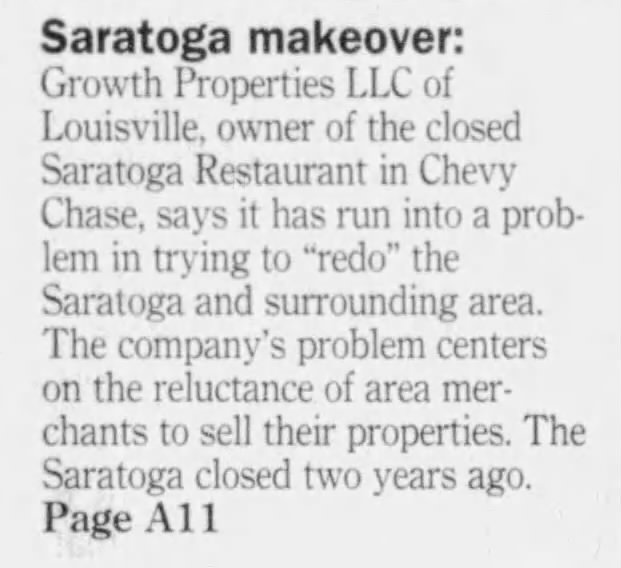 The makeover problem, at a glanceThis short news pointer says Growth Properties LLC of Louisville, owner of the closed Saratoga property, was having difficulty redeveloping the restaurant and surrounding area. It attributes the difficulty to neighboring merchants’ reluctance to sell and says Saratoga had closed two years earlier.
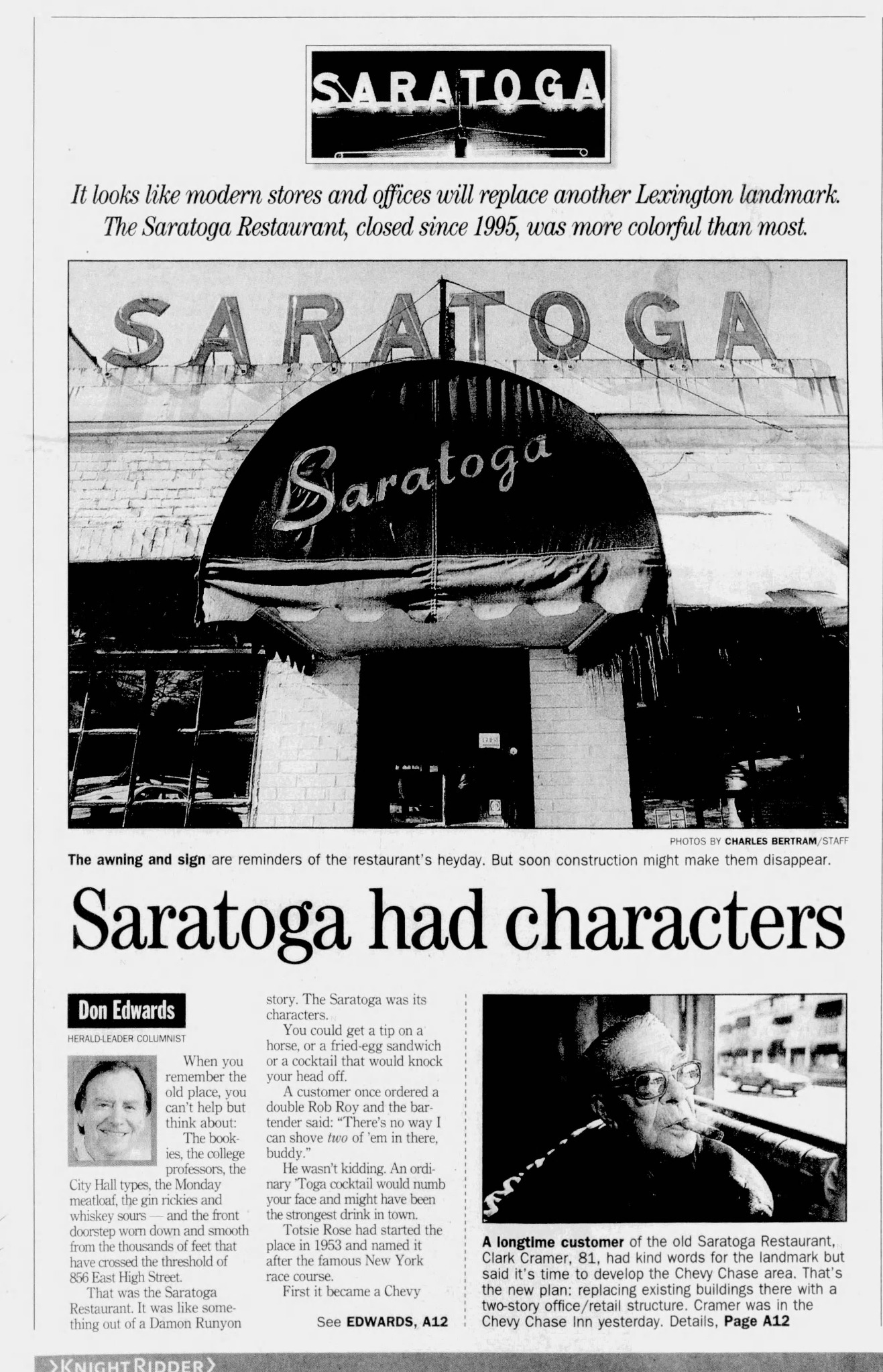 “The Saratoga was its characters”Don Edwards recalls Saratoga’s customers, Monday meatloaf, fried-egg sandwiches and famously strong drinks while the page introduces plans to replace the closed restaurant with stores and offices. Charles Bertram’s photographs show the awning and rooftop sign still in place; a caption identifies longtime customer Clark Cramer and describes a planned two-story office-and-retail building.
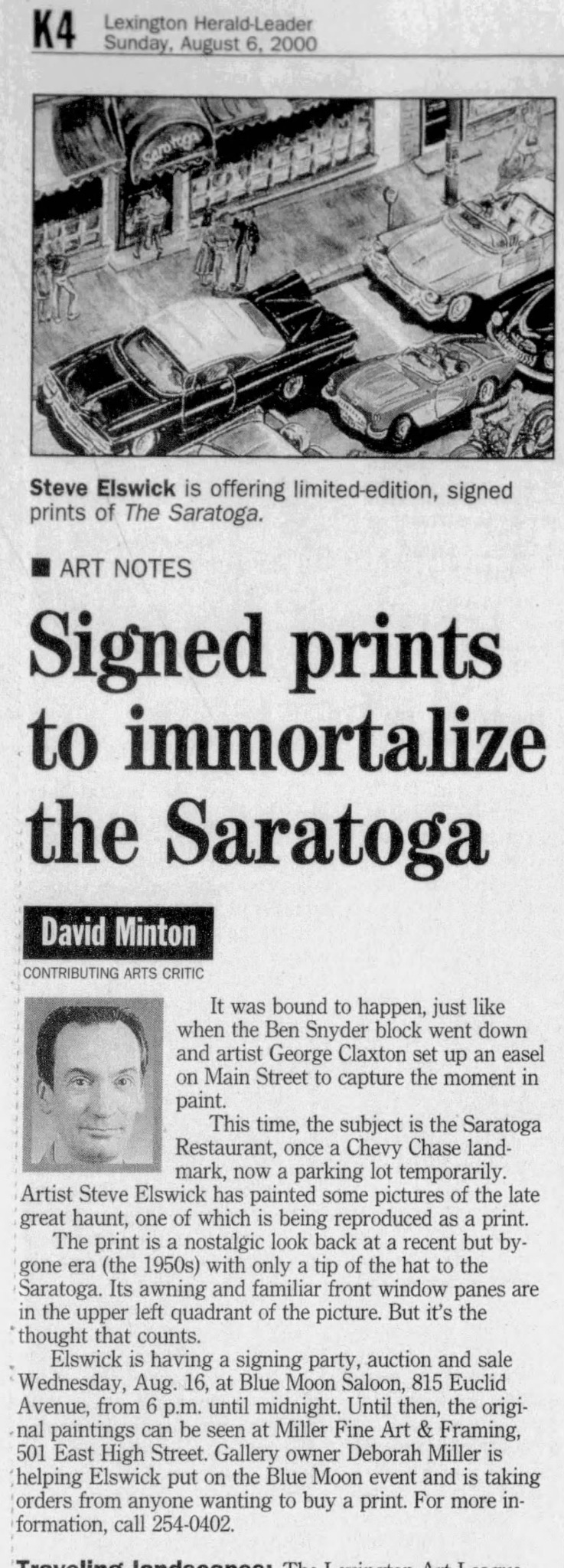 The building is gone. The pictures begin.David Minton’s Art Notes column describes the former Saratoga site as a temporary parking lot and reports Steve Elswick’s paintings and limited-edition signed prints of the restaurant. A signing party, auction and sale was planned for August 16 at Blue Moon Saloon, with originals on view at Miller Fine Art & Framing.
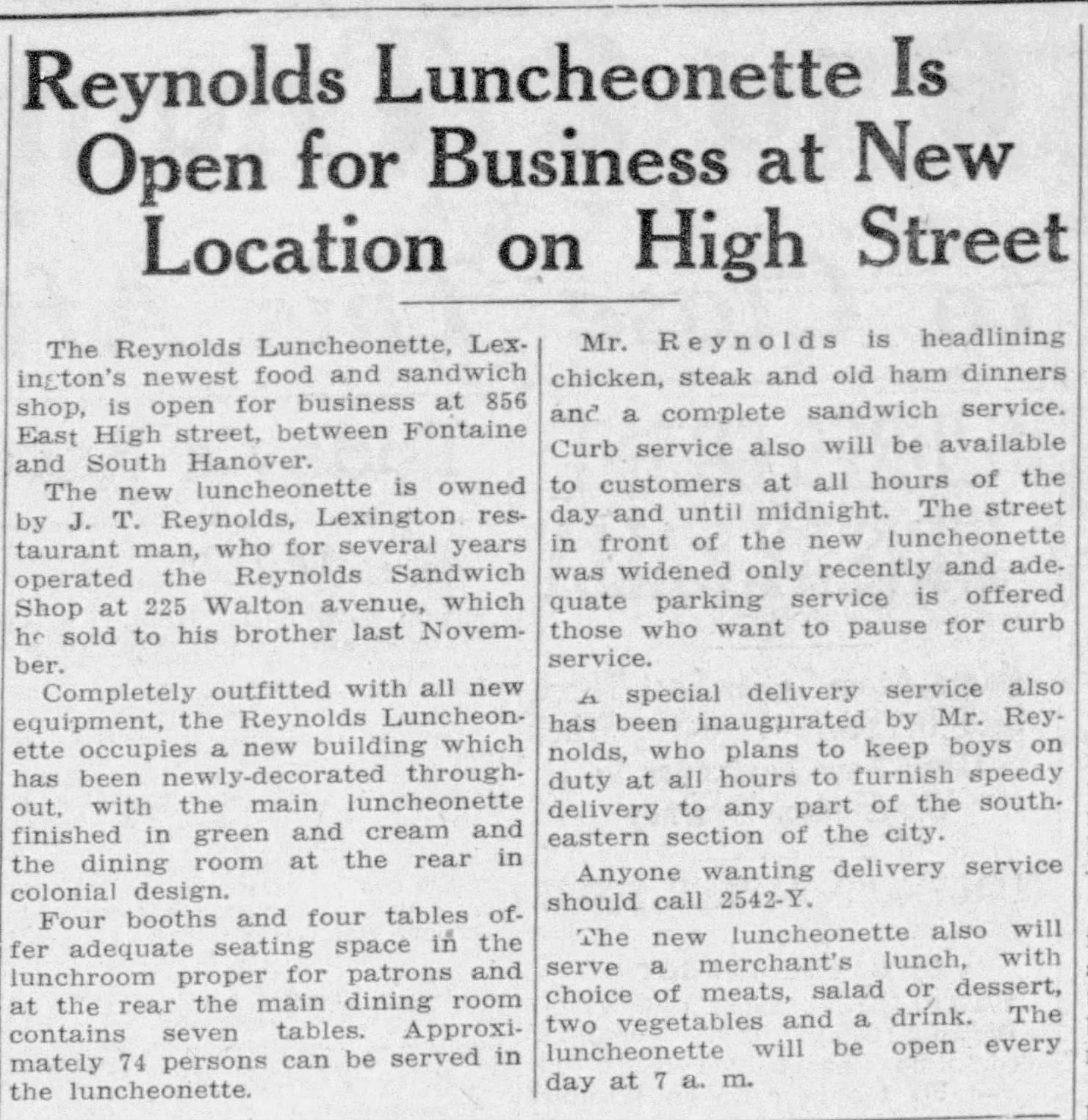 A second account of the new luncheonetteThe opening report describes four booths and four tables in the front lunchroom, seven tables in the rear, and chicken, steak, old ham dinners, sandwiches and a merchant’s lunch.
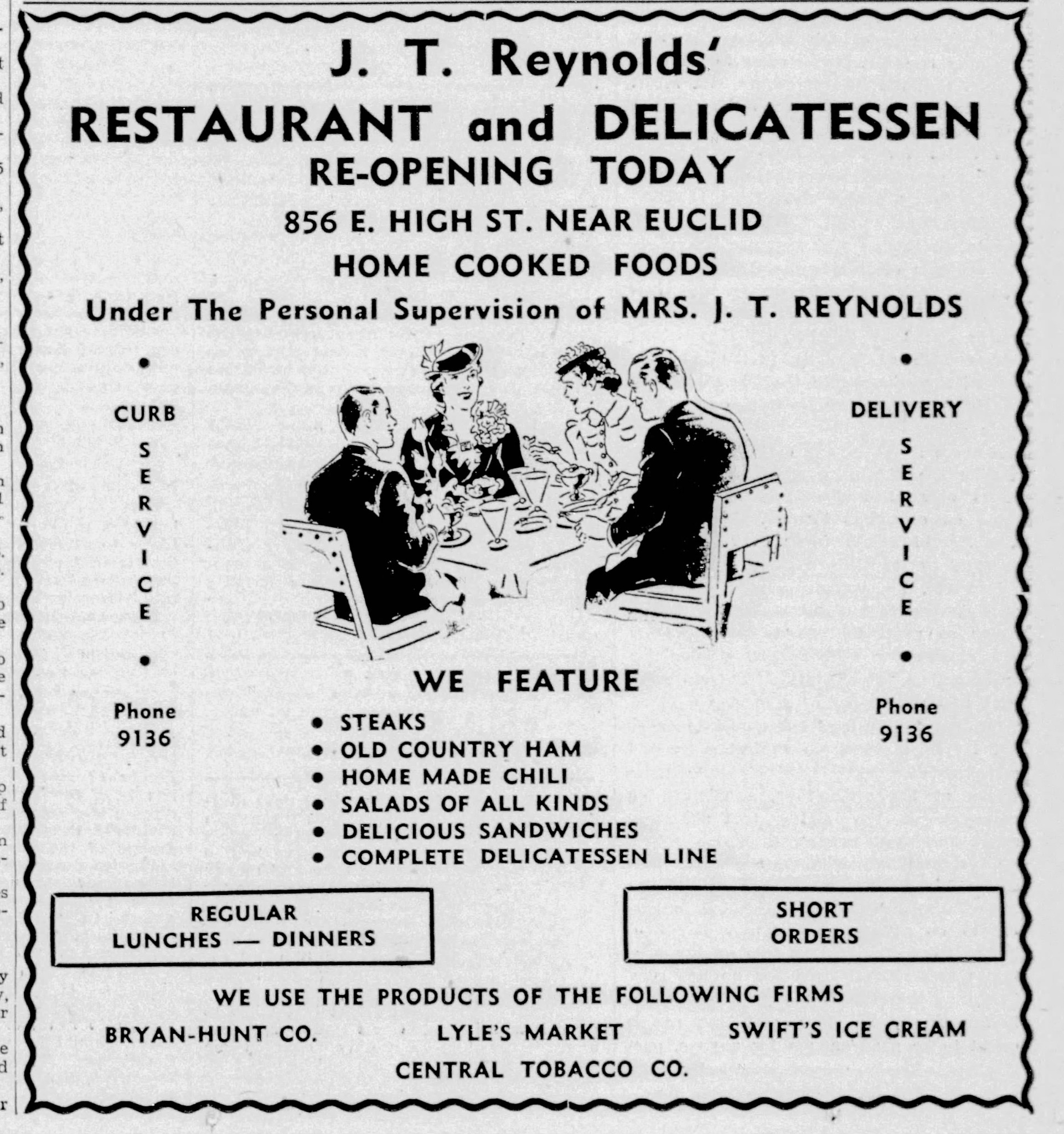 The reopening advertised in another paperA second newspaper placement of the restaurant and delicatessen reopening ad.
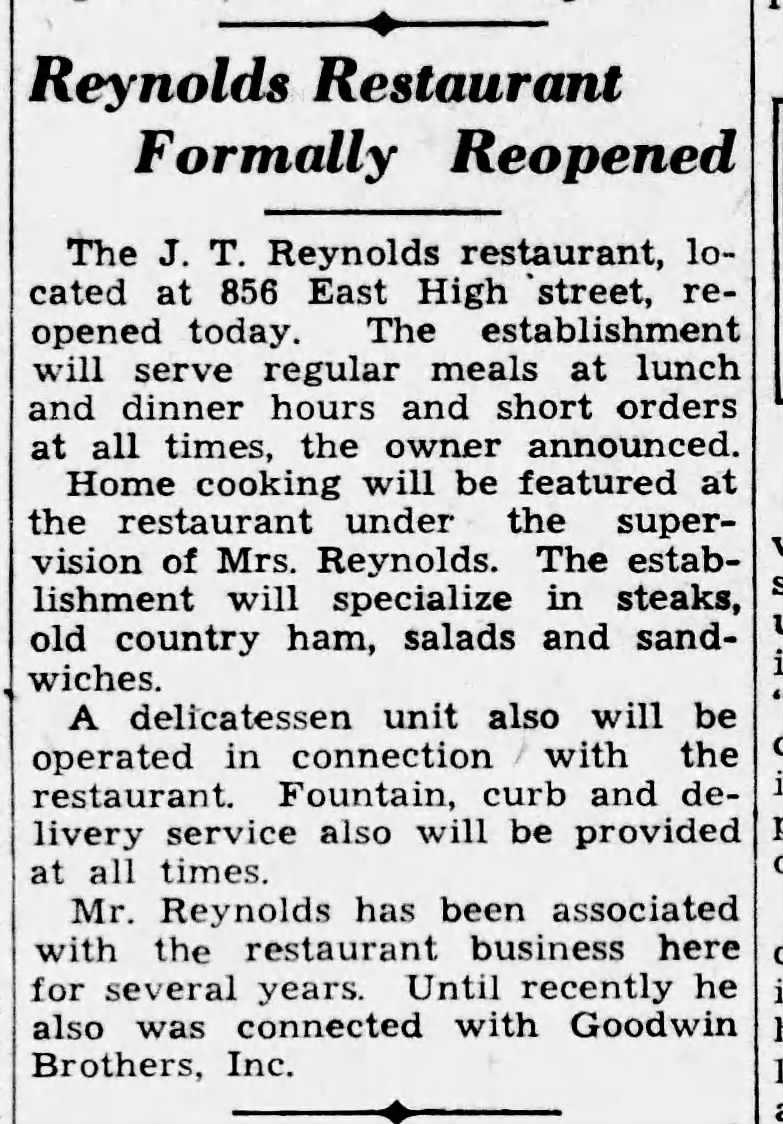 “Reynolds Restaurant Formally Reopened”The news report confirms the reopening, regular lunch and dinner service, short orders, a delicatessen, fountain, curb and delivery service.
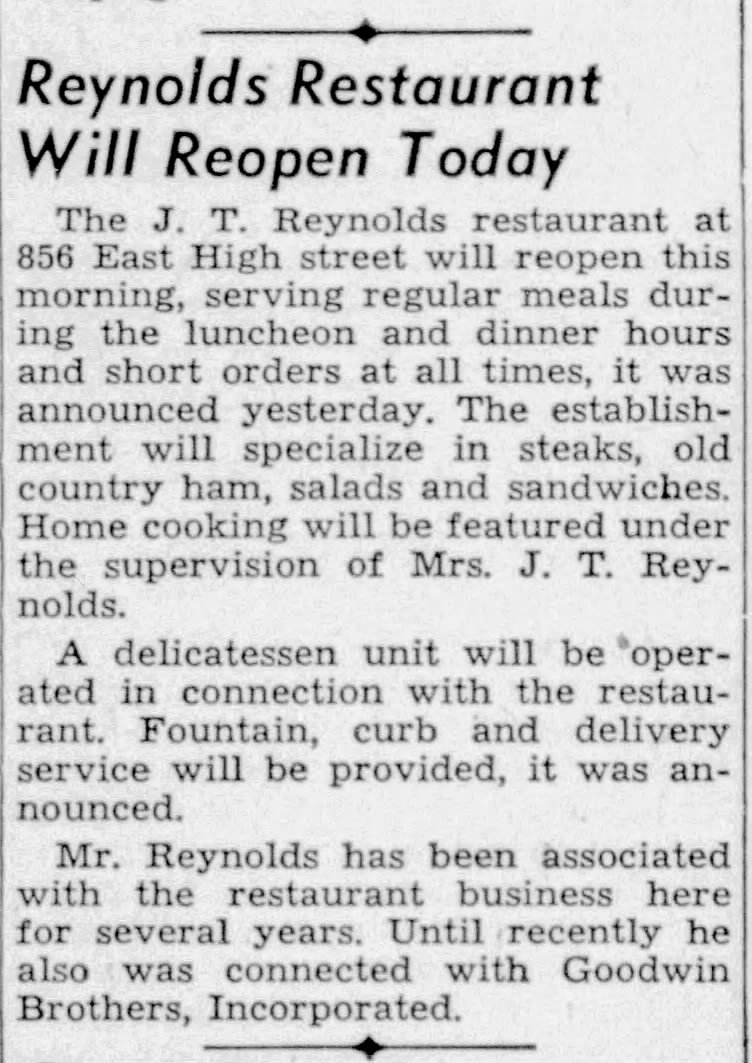 The morning reopening announcement“Reynolds Restaurant Will Reopen Today” previews the reopening at 856 East High.
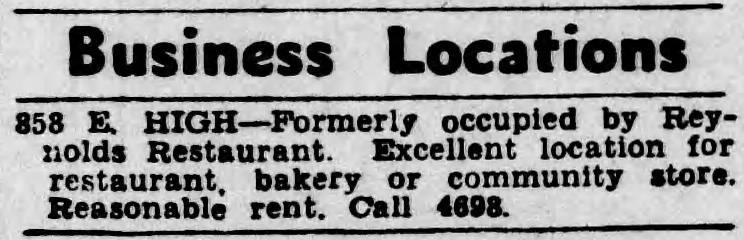 Former restaurant premises offered for rentFormer Reynolds premises offered for rent. This ad prints 858 East High, an unresolved difference from the usual 856 address.
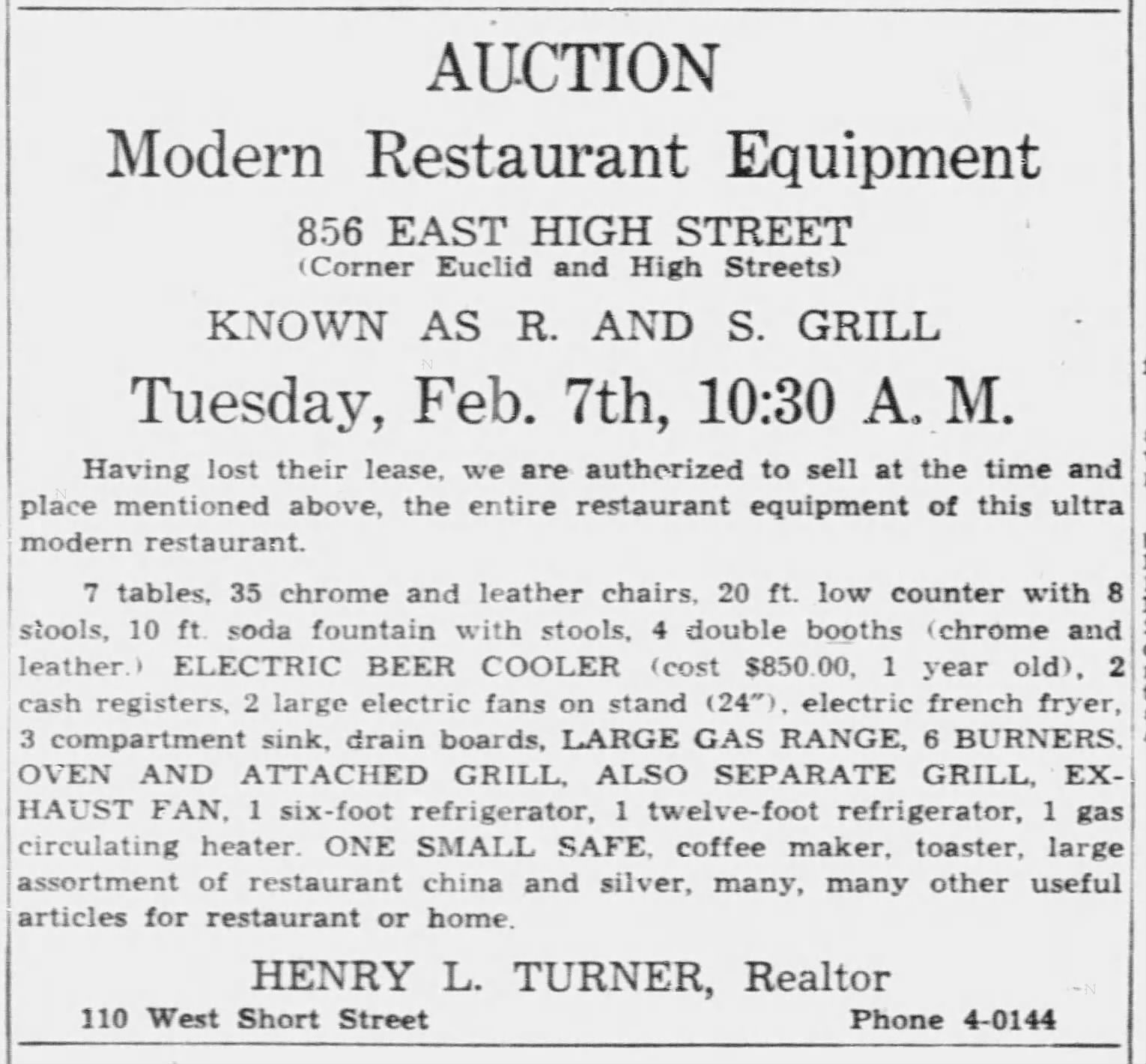 R. & S. Grill has lost its leaseAfter losing its lease, R. & S. Grill advertised its restaurant equipment for auction on February 7, 1950.
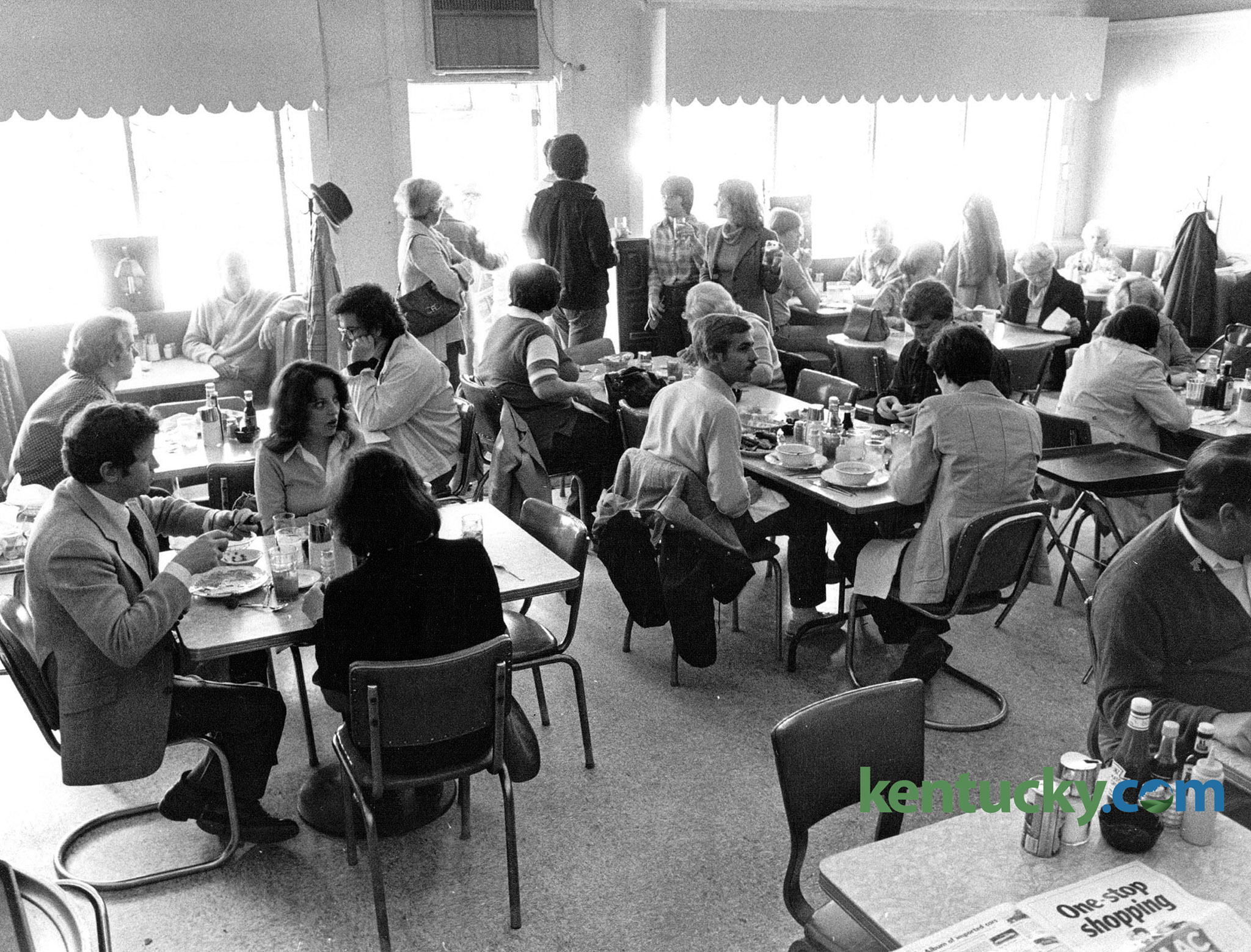 A seat at Saratoga RestaurantSmall tables, coat stands, a busy server and a room full of diners. The photograph preserves the restaurant as a lived-in gathering place. The people shown are not identified in the archive caption.
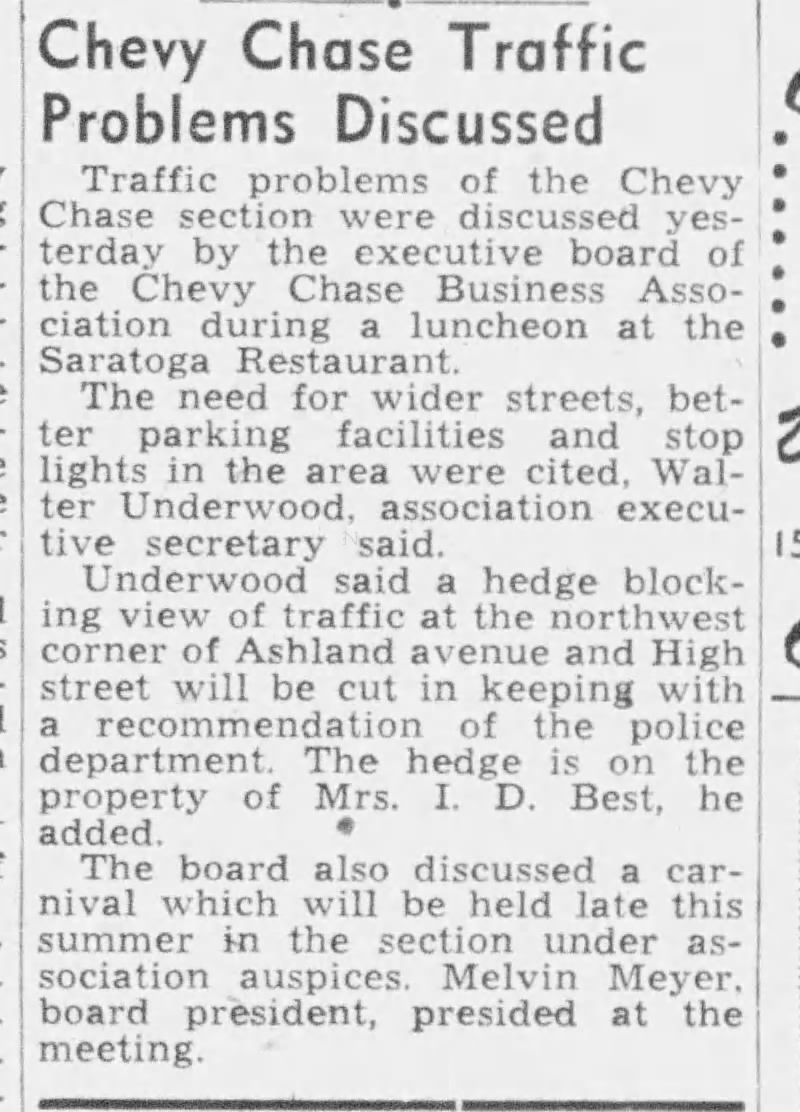 The neighborhood’s meeting roomThe executive board of the Chevy Chase Business Association met for lunch at Saratoga to discuss wider streets, better parking and stoplights. Walter Underwood also reported that a hedge obstructing sightlines at Ashland Avenue and High Street would be cut following a police recommendation; the group discussed a summer carnival.
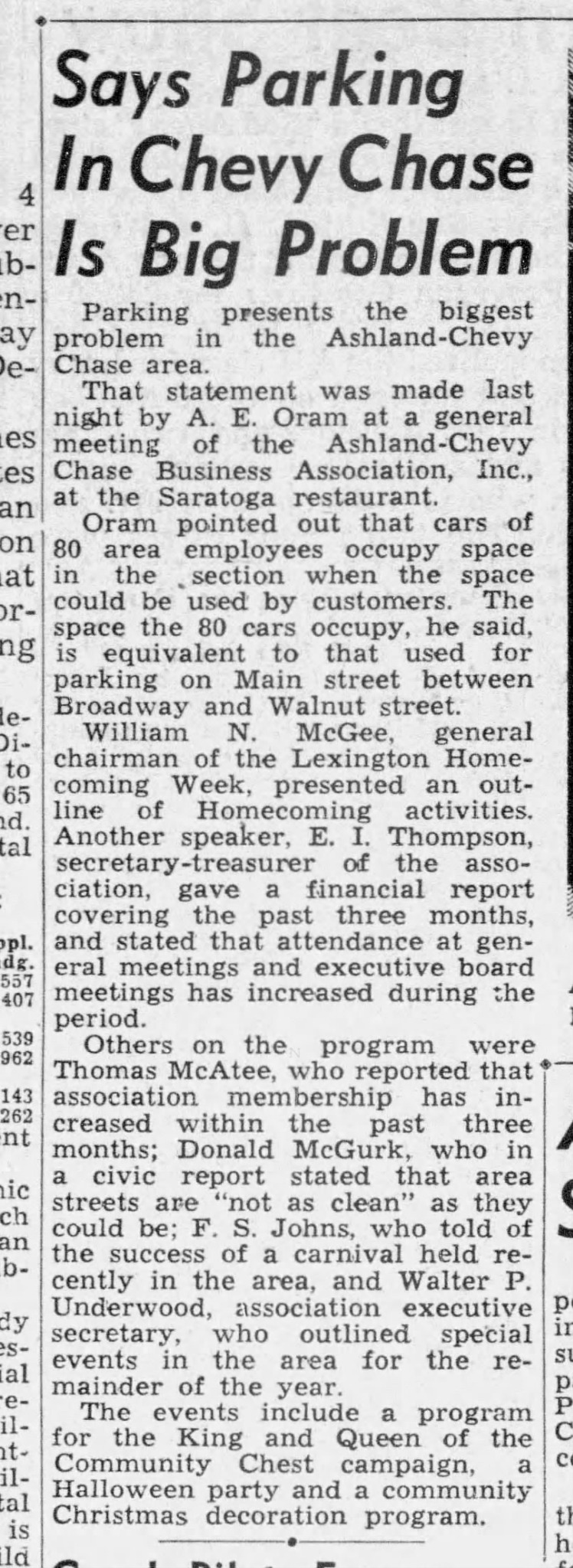 Parking was already the problemAt an Ashland–Chevy Chase Business Association meeting at Saratoga, A. E. Oram called parking the area’s largest problem. He said cars belonging to 80 area employees occupied spaces that customers could use; the meeting also covered Homecoming, street cleanliness, association growth and holiday events.
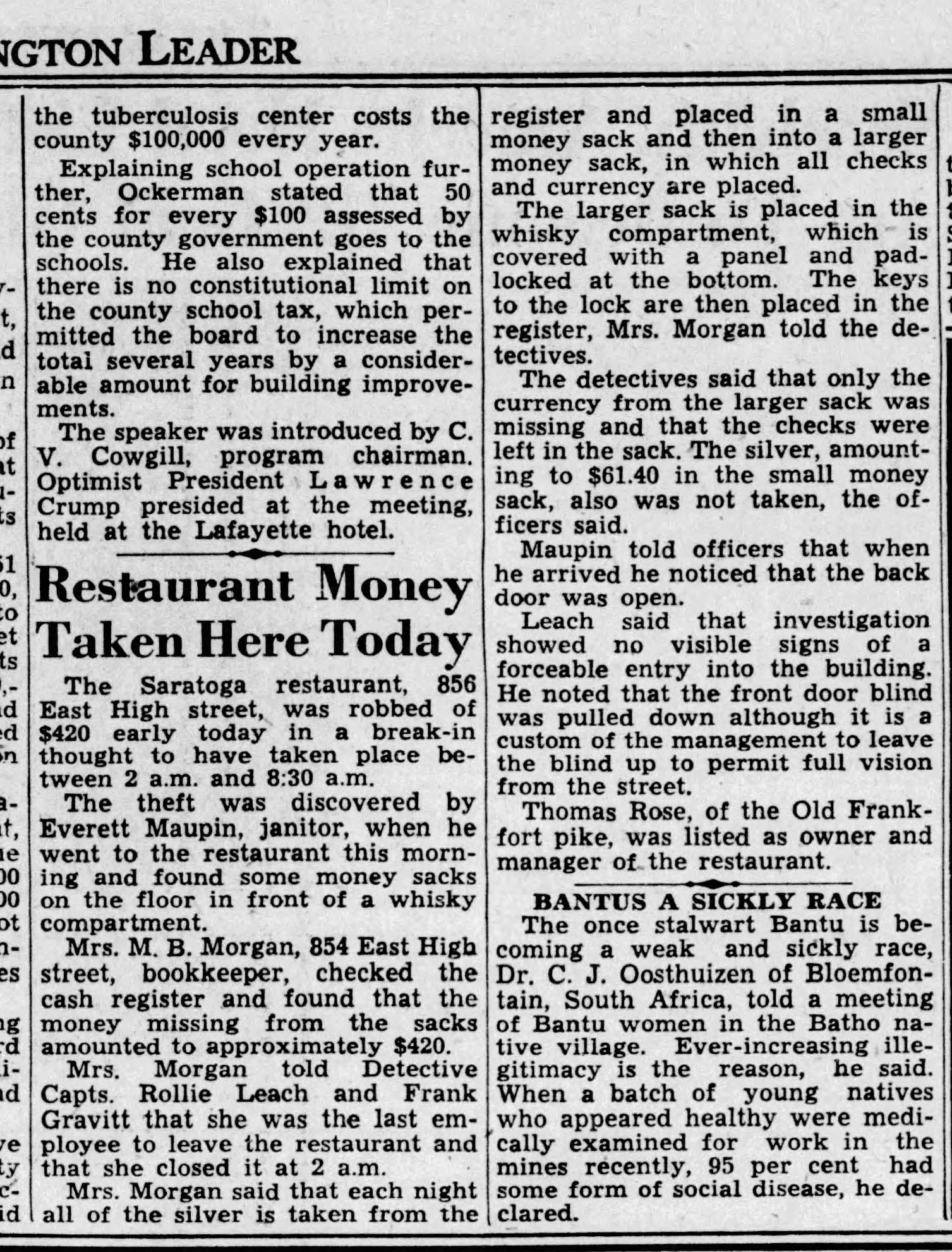 Cash only. Apparently.The reported take: $420. The checks and $61.40 in coins stayed put.
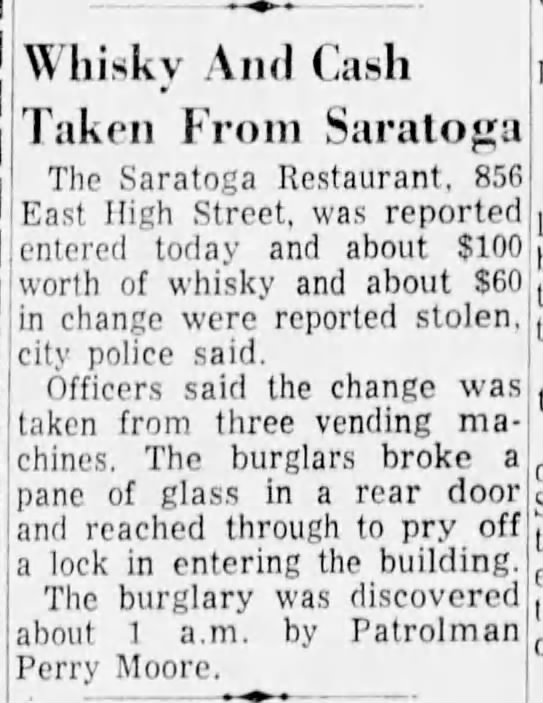 A takeaway order nobody approvedAbout $100 in whisky, plus the vending-machine change.
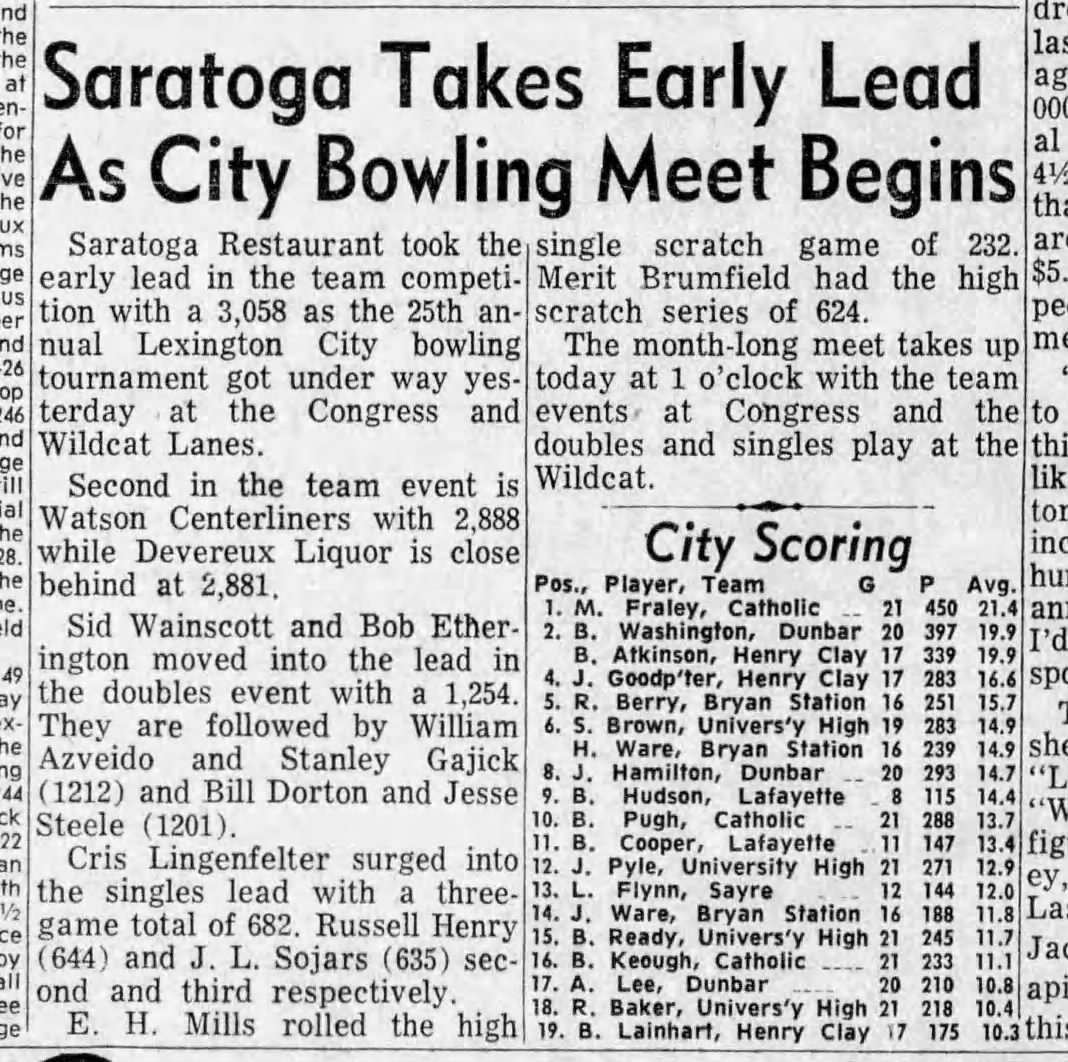 The ’Toga goes bowlingSaratoga Restaurant led the opening team competition in the 25th annual Lexington City bowling tournament with 3,058. The report names Congress and Wildcat Lanes as tournament venues.
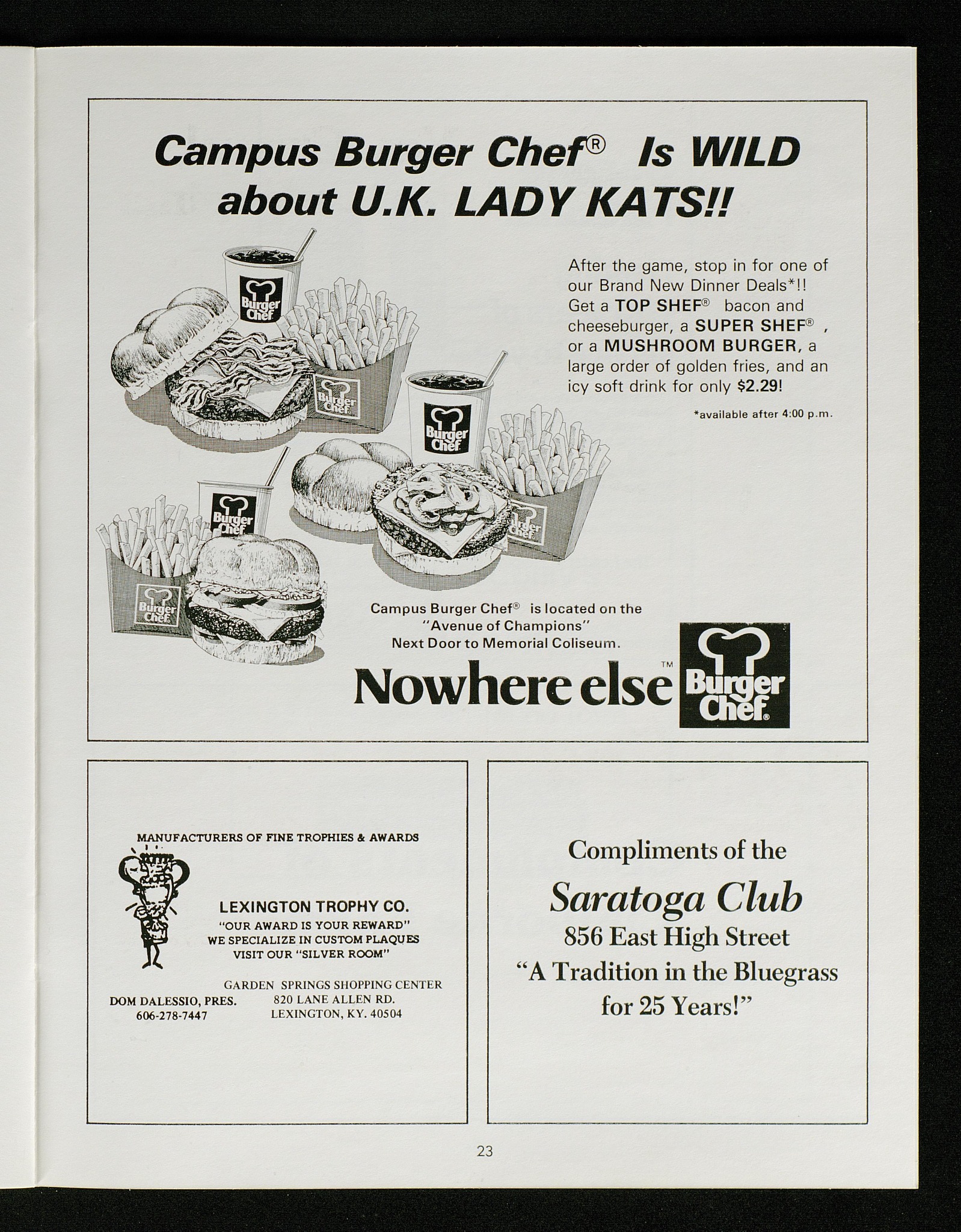 Compliments of the Saratoga ClubAn address, an anniversary claim and a place in UK sports ephemera.
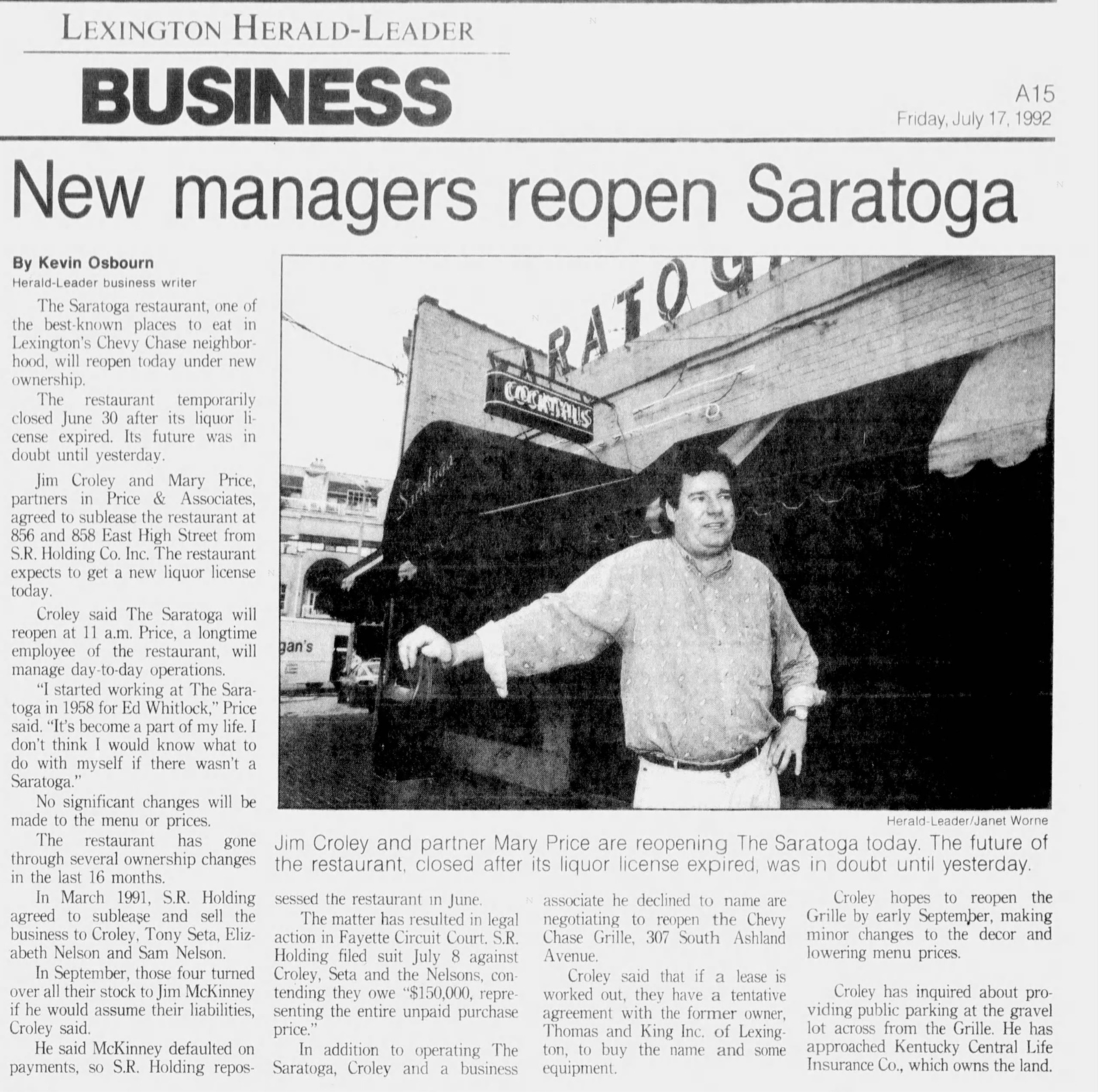 Mary Price reopens Saratoga RestaurantKevin Osbourn reports a planned 11 a.m. reopening that day under Price & Associates, the partnership of Mary Price and Jim Croley, following a June 30 closure when the liquor license expired. Price, who began working for Whitlock in 1958, would run daily operations without significant menu or price changes; the story also documents the otherwise omitted 1991–92 transfers and a pending purchase-price suit.